We’ve been asking for AI performance reporting for a long time, and Bing just delivered something that actually matters: real visibility into when your content is cited inside AI-generated answers.
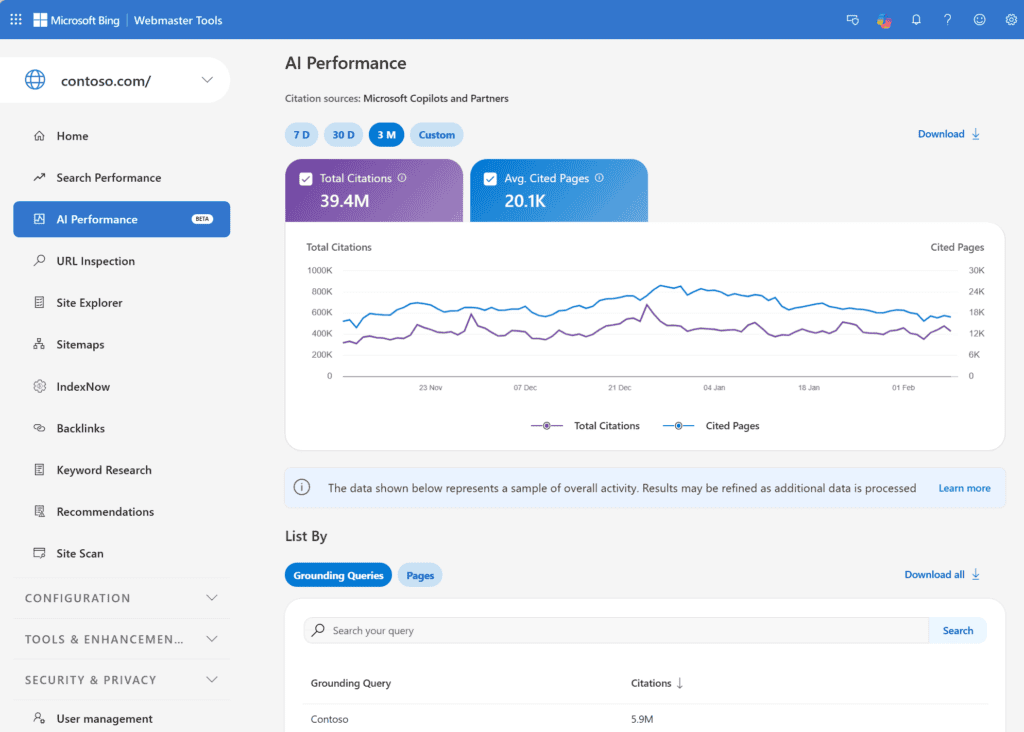
Microsoft is calling this AI Performance inside Bing Webmaster Tools (public preview), and it’s one of the first platform-level dashboards that helps publishers understand how their content shows up across Microsoft Copilot, AI-generated summaries in Bing, and select partner integrations.
Official announcement: Introducing AI Performance in Bing Webmaster Tools (Public Preview)
Why This Report Is a Big Deal
Most measurement frameworks are still stuck in “blue link” thinking: impressions, clicks, average position. That’s fine, but AI discovery is different. In AI experiences, the win isn’t just a ranking it’s whether you’re used as a reference.
This is the missing layer: you can now see which pages are being pulled into AI answers, which queries are driving that, and whether your visibility is trending up or down over time. In other words: you can finally validate what’s working.
Where to Find AI Performance in Bing Webmaster Tools
- Log into Bing Webmaster Tools.
- Select your verified property (website).
- Navigate to the new AI Performance section (public preview).
- Set your date range to analyze changes over time.
If you’re actively investing in content updates, technical SEO, or GEO experimentation, this is where you go to see if your work is paying off.
Everything Inside the AI Performance Dashboard (What Each Section Means)
Total Citations
This shows the total number of citations where your content was displayed as a source inside AI-generated answers during your selected time range. It’s not telling you “rank” or “placement.” It’s telling you: how often you’re referenced.
Average Cited Pages
This shows the average number of unique pages from your site that are cited per day over the selected period. I like this metric because it tells you whether your AI visibility is concentrated (one hero page) or distributed (multiple pages carrying influence).
Grounding Queries
This is where it gets fun. Grounding queries show the key phrases AI used when retrieving content that ended up being cited. Think of these as AI retrieval intent signals. You can use them to validate what AI thinks you’re relevant for—and identify what to build next.
Page-Level Citation Activity
This section shows citation counts for specific URLs, so you can see which individual pages are being referenced most often. This is the “priority list” feature because now you know which pages are most important to protect, improve, and expand.
Visibility Trends Over Time
This timeline shows how your citation activity changes over time across supported AI experiences. This is the section that helps you connect cause and effect: publish, update, improve, deploy then watch the trend.
Microsoft also notes that AI Performance respects preferences expressed via robots.txt and other supported control mechanisms, which is important for publishers and compliance teams.
How to Use This Data Like a Pro (What I’d Do First)
- Identify your “AI winners”: Sort by page-level citation activity and pull the top cited URLs.
- Map winners to grounding queries: Confirm the topics and intent patterns that trigger citations.
- Create more of what AI already trusts: Build adjacent content, deepen supporting sections, and expand coverage around those themes.
- Update and protect cited pages: Those URLs are already in the AI system. Keep them accurate, current, and well-structured.
- Watch trends after changes: Use visibility trends over time to validate what’s actually moving the needle.
This is the part that changes the workflow: you’re no longer guessing what “AI-friendly content” means. You’re using real platform feedback to prioritize.
What Bing Says Will Improve AI Citation Visibility (And Why They’re Right)
Bing’s recommendations are basically the timeless SEO fundamentals now applied to AI inclusion and citation behavior. Here’s what they specifically call out, and how I’d interpret it operationally:
Strengthen Depth and Expertise
Pages cited for specific grounding query phrases tend to have clear subject focus and real coverage. If you’re thin, you’ll get passed over. Build content that answers the full question, not just a slice of it.
Improve Structure and Clarity
Headings, tables, and FAQ sections aren’t “nice to have.” They make it easier for systems to extract and reuse information accurately. If your content is a wall of text, you’re making it harder than it needs to be.
Support Claims With Evidence
Examples, data, and cited sources build trust when your content is reused. If a page makes big claims without support, it’s weaker than it looks.
Keep Content Fresh and Accurate
AI systems need current information. If your best pages are stale, you’re leaving visibility on the table. Make updates part of your content operations, not a once-a-year panic.
Reduce Ambiguity Across Formats
If your text says one thing, your images imply another, and your video contradicts both—you’re confusing the system. Align entities, terminology, and core claims across all formats.
IndexNow: The “Freshness Lever” That Matters More Now
Bing’s callout on IndexNow is not subtle and honestly, it shouldn’t be optional anymore if you’re serious about AI visibility. IndexNow helps notify participating search engines when content is added, updated, or removed, so systems can discover changes faster.
If you want to get started or validate implementation, go here: IndexNow.org (and the IndexNow documentation if you’re technical).
In real-world terms: if you’re improving pages that are already getting citations, IndexNow helps reduce the lag between “we fixed it” and “the ecosystem reflects it.”
Local Businesses: Don’t Skip Bing Places + Structured Data
For local businesses, AI answers are often driven by consistent, verified business data. Bing explicitly points to keeping business information current.
If you’re not claimed and maintained in Bing Places, that’s a gap. Start here: Add and manage your business listing (Bing Places for Business)
Pair that with schema and clean on-site location data, and you’re stacking the kind of signals AI systems can confidently reuse.
What This Means for Content Strategy in 2026
Here’s the practical shift: you’re no longer optimizing only for rankings and clicks. You’re optimizing for citation eligibility and reference frequency.
This report gives you a new loop: Measure → Identify cited pages → Improve the pages AI already trusts → Publish more of the winning patterns → Track trend movement.
In a world where discovery is increasingly happening inside AI experiences, being cited is the new visibility layer that matters. Bing just gave publishers a dashboard to compete on it.