May 21, 2026 · 10 min read
Google Marketing Live 2026: What You Need to Know
I am not exaggerating when I say we have seen a decade’s worth of innovation land in the last 12 months alone.
Just on the heels of the massive architecture shifts at Google I/O, Google just dropped its annual Google Marketing Live (GML) 2026 keynote and it completely rewrites the operational playbook for digital advertising.
Google Marketing Live: Watch a Video or Read Below
If you’re running campaigns the exact same way you did even six months ago, you are actively leaving money on the table.
Google is officially moving us toward true, real-time, outcome-based marketing in milliseconds. We are talking about a closed-loop system where your insights talk to your creative, your creative talks to your media bidding, your media talks back to your measurement, and deep automation feeds the whole ecosystem back as it learns.
I just processed the entire event, the underlying developer roadmaps, and the data-drops so you don’t have to.
Let’s dive into the massive updates from Google Marketing Live 2026 that you need to implement immediately to stay ahead of the competition.
1. Reinventing Formats for the “AI Mode” Search Era
Google Search is experiencing an unprecedented surge, with total search queries reaching an all-time high last quarter.
Why?
Because users have rapidly adopted “AI Mode” to ask long, complex, highly conversational questions they never could execute within a traditional search engine index.
Previously, these long-tail, hyper-specific queries were incredibly difficult for digital advertisers to match cleanly with creative. That is no longer the case. Google is entirely reinventing what an ad looks like in conversational search interfaces.
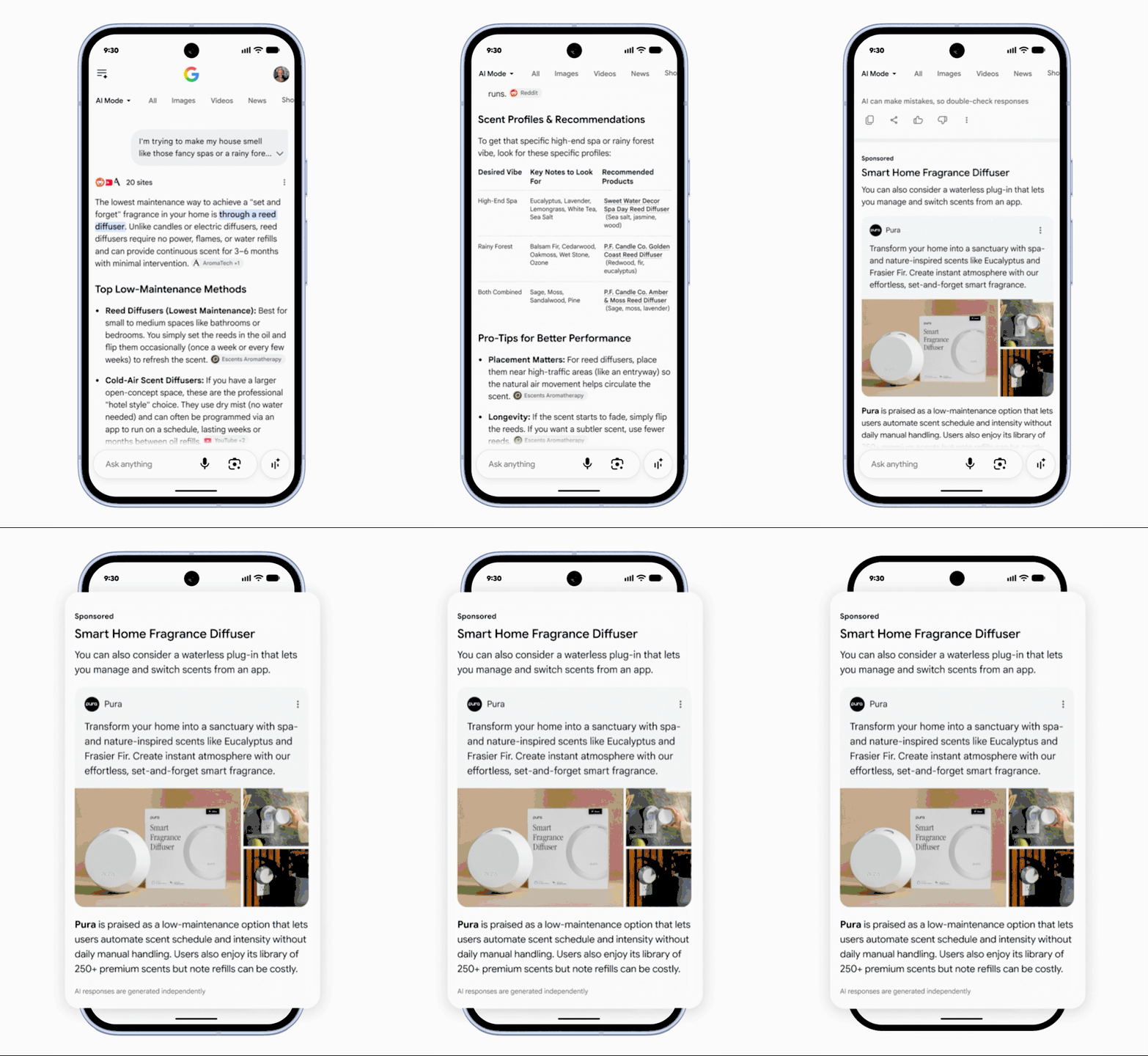
Next-Gen Dynamic Conversational Ads
When a user asks a multi-layered question in AI Mode (e.g., “What are some low-maintenance ways to make my home smell amazing?”), the search bar does not simply return a standard grid of blue links. It delivers a deeply contextual, Gemini-generated summary. Google’s new ad formats live natively inside this chat workflow:
- The Grown-Up Shopping Ad: Products recommended contextually by Gemini are linked directly to specific retailers who have them in verified, *real-time local stock*.
- Direct Offers: Instead of static, hard-coded promotions, you input your products and your seasonal promotional rules. Gemini then dynamically generates a bespoke, hyper-targeted offer (such as custom cross-merchant bundles or local proximity coupons) at the exact millisecond the user shows high purchase intent.
Business Agents for Lead Gen
For B2B and enterprise lead-generation marketers, this marks a massive paradigm shift. Google introduced conversational, agentic lead ads.
In the live platform demo featuring a top business school, an end-user could query a custom question *inside the ad unit itself*. The AI pulled live answers directly from the advertiser’s web domain, handled the natural language back-and-forth, and pre-filled an interactive lead form natively using Google profile data.
The result? **Hyper-qualified leads passing into your CRM with absolutely zero landing page friction.**
2. Setting Campaign Guardrails with “AI Brief” for AI Max
If you want to win in this fast-evolving conversational search landscape, you have to fully lean into automated multi-channel architectures.
Google confirmed at the event that advertisers who fully adopt AI Max (or Performance Max) see an average of 15% more conversions at a similar ROAS. For an official breakdown of how these algorithms balance budgets, check out the Google Marketing Live 2026 Bidding and Budgeting Updates.
But as a growth marketer, I know what your biggest hesitation is: brand safety and structural control. To solve this dilemma, Google officially launched AI Brief for all active AI Max campaigns.
What is AI Brief? Think of it like giving a professional human agency a comprehensive creative brief, but doing it entirely in natural, conversational instructions inside your Google Ads dashboard.
Instead of letting the algorithm guess your brand boundaries, you pass the AI explicit guardrails, target audience parameters, and strict negative conditions in plain English. The engine interprets your text, builds automated layout guidelines, and gives you real-time creative previews so you can refine its understanding before a single dollar of media spend is deployed.
3. Meet “Ask Advisor”: Your Unified AI Marketing Core
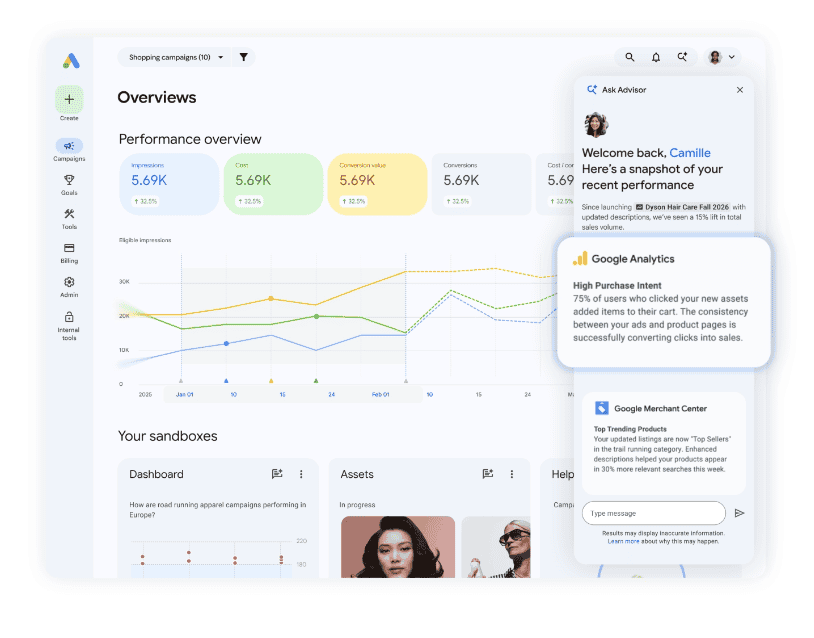
Marketers shouldn’t need a PhD in advanced data analytics just to scale their daily business operations. Instead of managing a disjointed family of isolated AI assistants across five different product dashboards, Google is consolidating everything into a singular, cross-product agent: Ask Advisor.
Built natively on the latest Gemini models, Ask Advisor creates a continuous thread of predictive intelligence across your entire Google enterprise stack.
Soon, you will be able to open any Google enterprise tool and conversationally prompt Ask Advisor to execute cross-platform tasks, surface budget anomalies, or push real-time bid adjustments. Additionally, Google integrated three new agentic safety and policy features directly into Ads Advisor to help protect account compliance and automatically resolve merchant center policy flags before they disrupt your active campaigns.
4. Reimagining Google Analytics 360 as the Ultimate Customer Command Center
Legacy attribution models built entirely on “clicks” are systematically broken. They fail to account for modern user behavior, especially on highly visual and assistive platforms. To address this structural issue, Google has completely overhauled Google Analytics 360 to serve as a modern command center for omnichannel measurement.
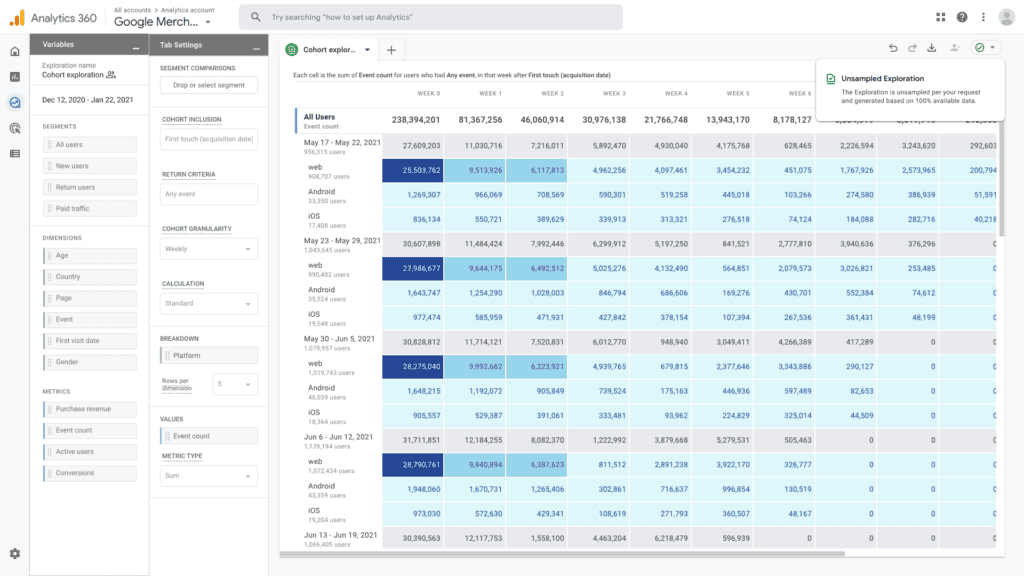
Turning Data Into Performance Decisions
- First-Party Data Strengths: Google’s corporate data proves that brands building data maturity via first-party infrastructure capture an 11% average increase in incremental ROAS.
- Attributed Branded Searches: GA360 and Google Marketing Platform can now track short-term causality by explicitly measuring the volume of branded searches directly generated by your mid-and-upper funnel video campaigns.
- Qualified Future Conversions: To solve the long-term attribution gap, this new predictive metric connects top-of-funnel signals (like video views, site visits, or initial assistant interactions) to downstream conversions up to six months in advance.
- Meridian Open-Source MMM Integration: Google is bringing the intelligence of Meridian—its next-generation, open-source Marketing Mix Model—directly into GA360, giving enterprise brands a turn-key solution to see how budget changes impact true incremental ROI.
5. YouTube & Demand Gen: Predicting Consumer Intent
YouTube continues to completely dominate attention metrics, now reaching more than 90% of US adults and holding the absolute number one spot in streaming watch time for three consecutive years. The business impact is massive: when a YouTube creator reviews or talks about your product, viewers are 13 times more likely to search for your brand and 5 times more likely to buy.
Google revealed that Google and YouTube are present in a staggering 82% of all discovery journeys. In fact, in 89% of those purchase journeys, consumers use Google and YouTube *before* or entirely *instead of* traditional social media feeds.
The Demand Gen Multiplier
If you want the absolute highest performance out of your media mix right now, you need to pair your Search or AI Max campaigns with Demand Gen. Advertisers who add Demand Gen to their mix see a 10% higher ROAS and 12% higher sales effectiveness.
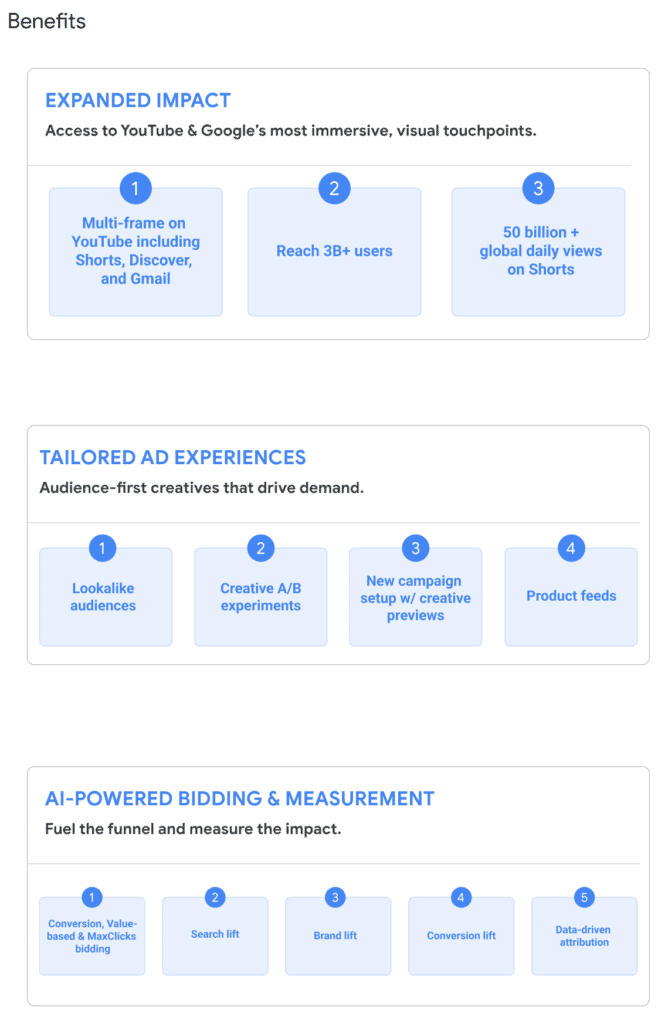
Why is it scaling so fast? Deep Gemini integration. The latest models don’t just match intent; they leverage billions of real-world context clues to actually *predict* what your customer will want next.
Major Demand Gen & YouTube Upgrades:
- Maps & New Placements Expansion: Demand Gen ads are officially expanding into Google Maps, tablet product feeds, and rolling out as “Pause Ads” starting on mobile devices.
- One-Click Creator Boosting: Adding creator assets to Demand Gen drives an average 20% conversion lift. Google Ads will now automatically surface high-performing YouTube creator affiliate videos featuring your brand, allowing you to boost them into active campaigns with a single click. For official instructions on setting up these assets, visit the Google Ads Product Support Center.
- Campaign Type Attribution: Legacy social platforms often count every passive, fractional impression as a “win” for their network, skewing your numbers. Google’s new campaign-type attribution explicitly highlights exactly what Demand Gen contributes along the conversion path, giving you clean data to show your CFO.
6. Scaling Video Creative with Asset Studio & Gemini Omni
The biggest bottleneck to scaling multi-channel performance campaigns has always been creative asset production. This summer, Google is injecting its flagship multi-modal engine, Gemini Omni, straight into Asset Studio to remove that execution friction completely.
Marketers can now generate high-velocity, high-performing video content from scratch using a streamlined, structural process within their dashboards:
- Narrative Selection: Choose the core angle, brand tone, and positioning guidelines for your campaign.
- Interactive Storyboarding: Asset Studio outputs a complete, frame-by-frame storyboard. You can conversationally swap scenes, edit design elements, or tweak the flow *before* rendering the final file.
- One-Click A/B Testing: Once generated, click “Save & Create Test” to instantly drop the new assets into an automated split-test against your current top-performing creatives.
7. The Era of Agentic Commerce (UCP & Universal Cart)
Google is setting the technical foundation for the future of “Agentic Commerce”—an ecosystem where AI agents and merchant platforms transact seamlessly via standardized rules.
Universal Commerce Protocol (UCP)
Co-developed with a cohort of global founding partners, UCP acts as a universal language for digital retail. Instead of internal engineering teams spending weeks writing custom API integrations for every new platform connection, UCP allows live inventory data, account linking, and brand loyalty benefits to flow instantly and securely to conversational consumer interfaces in real-time. Google is officially expanding UCP to new industry verticals this year. For more information on merchant deployment, visit the Google Merchant Center Developer Portal.
The Universal Cart & Instant Checkout
The Universal Cart acts as an intelligent, persistent hub across the entire Google ecosystem. Users can add items from different retailers (e.g., Nike and Wayfair) into one centralized cart while chatting with the Gemini app, watching a YouTube video, or reading a confirmation thread in Gmail.
The cart runs autonomously in the background—tracking price drops and alerting users when items are back in stock. When the consumer is ready to buy, Google is bringing native UCP-powered checkout directly into ad formats. YouTube ads will feature a “Buy Now” button that opens a pre-filled, branded checkout screen, letting users complete a purchase via Google Pay in seconds without ever leaving the video interface.
The Growth Playbook: Implement the “Brilliant Basics”
The gap between what Google’s AI marketing technology can do and what the average marketer is actually executing is wider than ever before. To help enterprise marketing teams close this gap, Google outlined what they call the ROI Essentials—or the Brilliant Basics.
If you want to maximize your returns in the age of agentic commerce, your immediate action items are clear:
- Clean up and structurally organize your first-party data pipelines to feed GA360 accurate, cookieless signals.
- Build an AI Brief to step up your AI Max campaign guardrails and scale total conversion volume safely.
- Blend Demand Gen with your core search infrastructure to capture predictive intent across YouTube and Maps.
- Transition your high-volume video workflows into Asset Studio to leverage Gemini Omni-driven video variations.
Overall, exciting times in digital marketing.