Home » How to Optimize for AI Search (Step-by-Step)
How to Optimize for AI Search (Step-by-Step)
Artificial intelligence is radically changing how users discover answers, interact with brands, and ultimately make purchasing decisions. As an executive, you can no longer rely on the playbooks of years past.
We are operating in a dual-front reality. First, we are utilizing advanced AI tools to execute marketing and technical SEO much more efficiently. Second, and crucially, we must optimize our brand’s entire digital presence to appear directly inside AI-generated answers and overviews.
Building this infrastructure early creates a compounding, durable competitive advantage that will drive immense long-term ROI.
The brands that master AI SEO today will dominate top-of-funnel visibility for their customers and that visibility will only grow.
This is the ultimate executive’s playbook for understanding, executing, and scaling an AI-driven search strategy.
What is AI SEO? The Executive Definition
At its core, AI SEO is the practice of optimizing your brand’s digital footprint so that large language models (LLMs) and AI-driven search engines inherently trust, retrieve, and cite your information as the definitive answer to a user’s query.
However, when I speak with CEOs and CMOs about this shift, there is one massive misconception that has to be corrected immediately.
Many executives believe these systems simply crawl the web independently and piece together a perfect summary based on the best-written blog post. The reality is much more structured and heavily dependent on consensus.
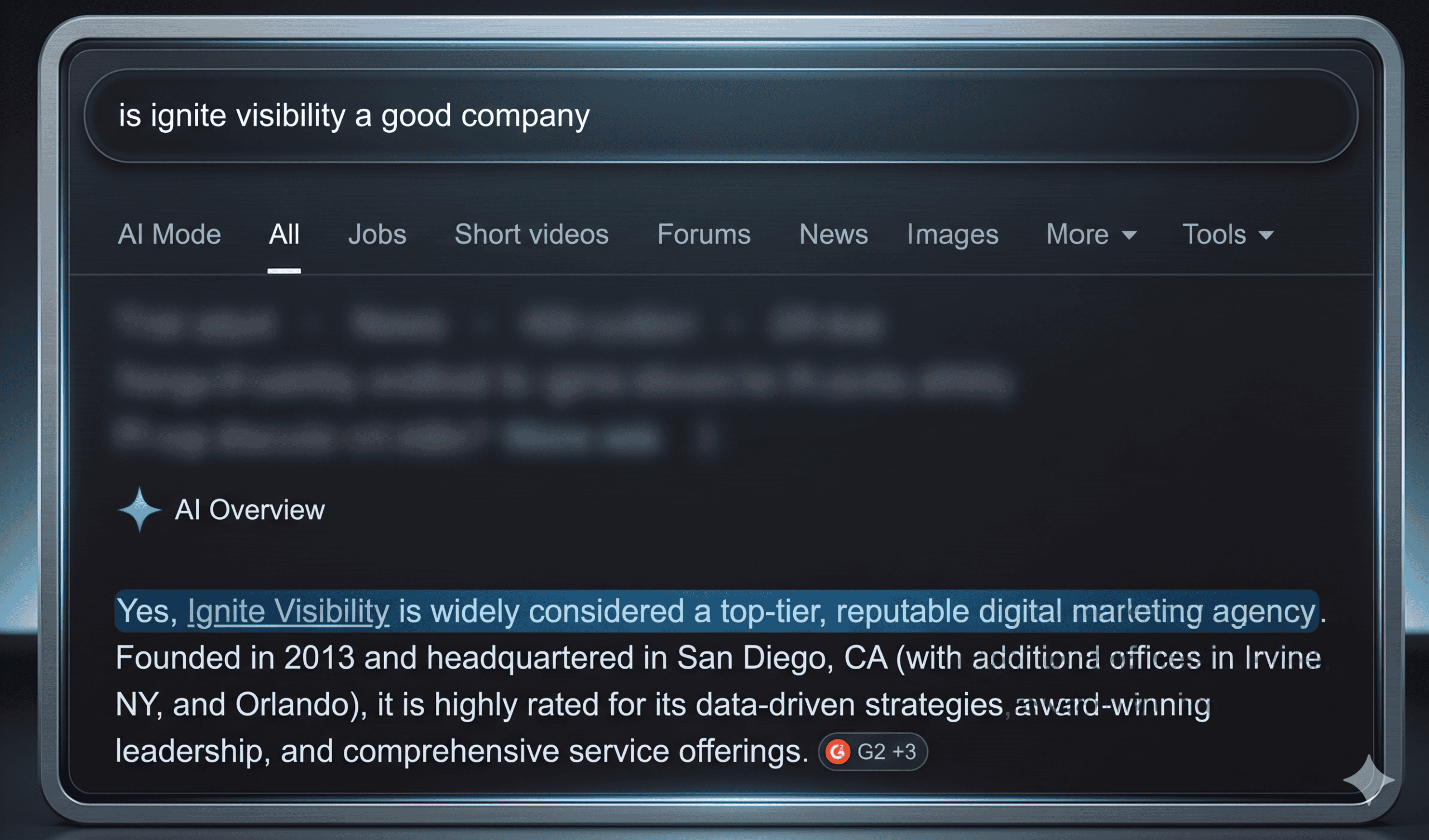
According to documentation on how AI Overviews operate, these features are specifically designed to surface information that is backed up by top web results. They evaluate trust signals across the entire web ecosystem to corroborate the information before citing the specific links from which they pulled the data. That is true of Google Gemini, ChatGPT and more.
To win in this new era, you need to have consistent information on your website and across the web on multiple highly credible properties in order to influence a decision. The “decision” in this context is the resulting content that is displayed in the AI response. If your brand’s data is fragmented, inconsistent, or isolated to just your own domain without third-party validation, the AI will not trust it enough to cite it.
How to Set Up an AI SEO Strategy
If you want to know how to set up an AI SEO strategy, you must start with the foundation: proactive data feeding and flawless crawlability. You can no longer publish a page and passively wait for a search engine crawler to discover it. It is much better to set up a system.
Feeding the Machine: Direct Indexing
AI systems do not always discover this information on their own. If you feed the information into the AI systems directly—either through conversational interactions, Google Search Console, or Bing Webmaster Tools—you are going to have a lot more information indexed quickly. For example, utilizing features like IndexNow allows you to instantly notify search engines the absolute moment URLs are added, updated, or deleted.
These timely notifications help the search engines prioritize crawling for these URLs, allowing them to quickly reflect these content changes in their search results. Actively managing your XML sitemaps and utilizing direct indexing APIs serves as a massive signal to indicate which URLs matter and when content changes.
Technical Crawlability, New Protocols, and the Language of AI
It is critical that your website is able to be crawled by AI bots and actively speaks the language of AI so that it can be interpreted well and easily. This means deploying precise Schema markup and structured data. Projects like Schema.org explicitly tell the AI who you are, what you do, and the exact steps of the processes you are outlining. Do not make the AI guess your context; spoon-feed it the exact parameters.
However, in 2026, standard Schema and a basic robots.txt file are no longer enough. You must adopt the new AI-specific protocols to truly optimize your footprint:
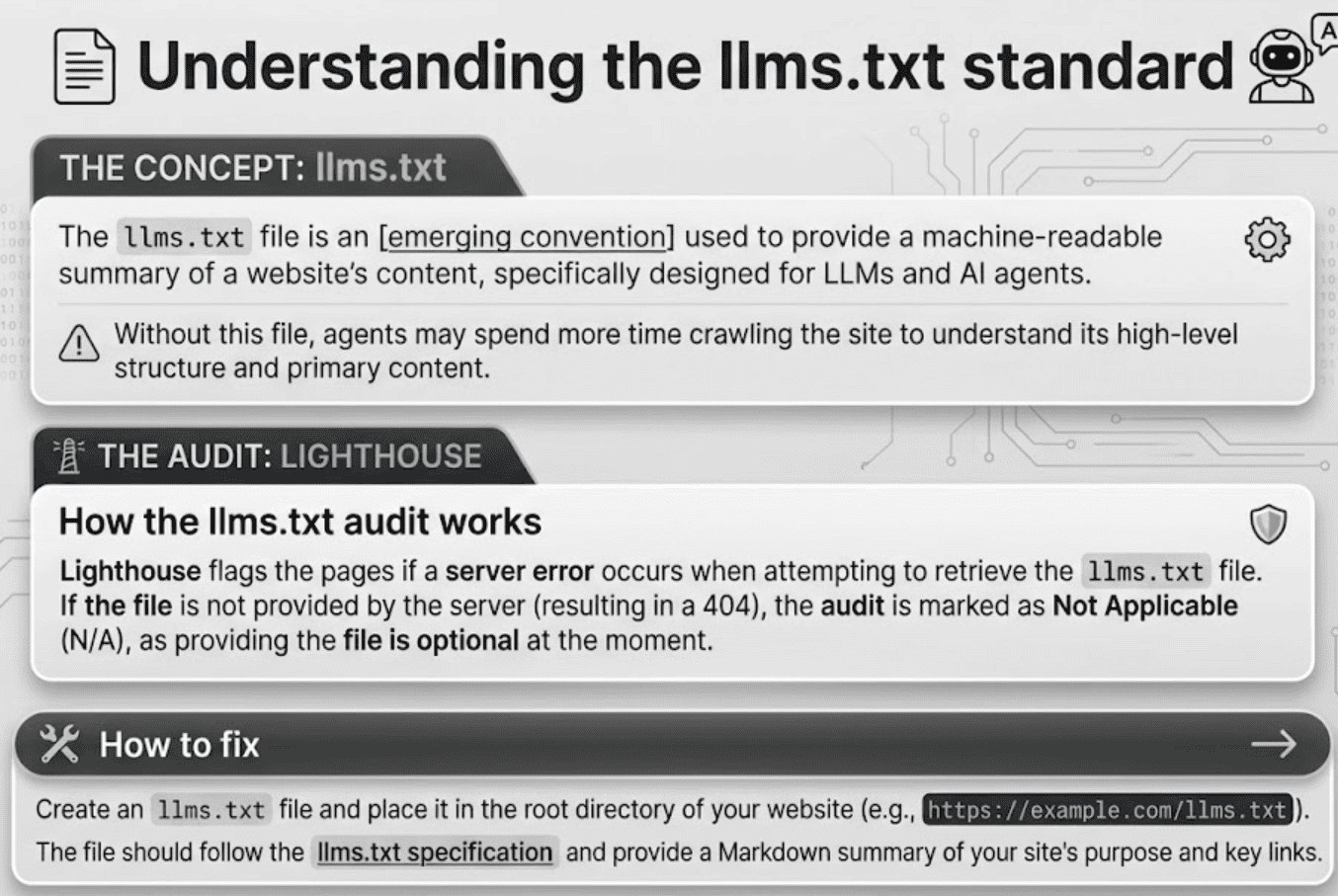
The llms.txt Protocol: You should implement an llms.txt file at your site’s root directory. This simple Markdown file gives AI systems a concise, clean summary of what your site is and points them directly to your most important, canonical source material. Instead of forcing a bot to scrape noisy pages, it curates the exact data you want the LLM to understand.
The ai.txt Protocol: While robots.txt only controls access, the emerging ai.txt standard allows you to define usage. It allows you to specify rules, such as allowing an AI to summarize your article for an AI Overview, while strictly forbidding it from extracting your images or using your proprietary data for model training.
Content Provenance (C2PA): To establish ultimate trust, you must verify your media. The Coalition for Content Provenance and Authenticity (C2PA) is an open technical standard that embeds cryptographically signed provenance metadata directly into your digital files. This creates a tamper-evident chain of custody. With major players like Google, OpenAI, and Meta adopting these standards, embedding C2PA Content Credentials proves your media is authentic and original, serving as a massive trust signal in an ecosystem flooded with synthetic content.
How to Get Into AI Overviews
Understanding how to get into AI overviews requires a deep dive into the mechanics of Google’s current systems. With recent core updates, Google has heavily emphasized surfacing content directly in AI overviews. These features are specifically designed to answer complex user queries without requiring an immediate click-through.
The GEO Playbook: Generative Engine Optimization
Getting your brand cited in an AI Overview requires a fundamental shift from traditional keyword stuffing to establishing unshakeable credibility. The best framework to achieve this is built on a foundation of factual, highly sourced, and rigorously verified content.
AI models are designed to find the consensus of truth. If your website publishes a claim, you must ensure that the exact same credible content is reflected across the web on major, authoritative third-party properties like Wikipedia, Reddit, Quora and major industry publications. When the AI cross-references your claims and finds them validated by other trusted sources, your probability of being cited skyrockets.
The E-E-A-T Mandate
Google evaluates the quality of search results based on the expertise, authoritativeness, and trustworthiness (E-E-A-T) of the content, relying on strict Quality Rater Guidelines. To optimize for AI Overviews, you must prove your expertise:
Demonstrate Real Experience: Google wants to see that the person behind the content has actually lived what they are writing about. Include original photographs, case studies, and concrete outcomes from your own experiments.
Build Trustworthiness: This is the most critical component. Ensure your site has a robust About page, secure HTTPS, clear contact information, and verified customer reviews on third-party platforms.
Establish Authority: Earn backlinks from respected websites and consistent brand mentions in industry publications.
How to Use AI for SEO: The Operational Playbook
It is critical that you have a documented monthly plan and an agile weekly sprint in place in order to create the type of content, technical requirements, and content syndication that you need.
Targeting the Three Pillars of Query Intent
Your operational playbook must systematically cover the full spectrum of user intent:
Top Branded Keywords: You must control the narrative when users ask an AI about your company. If someone types “What is the pricing model for [Your Brand]?” the AI must pull the exact, favorable data directly from your highly optimized, schema-rich pricing page.
Non-Branded Keywords and Questions: Capture top-of-funnel users seeking broad solutions. This is where comprehensive, E-E-A-T optimized “how-to” guides and proprietary research reports shine.
Competitor Queries: Position your brand strategically when users ask an AI to compare solutions in your industry. If a query is “Alternative to [Competitor],” your site needs a factual, well-structured comparison page that the AI can easily parse and present as the logical choice.
Behind the scenes, top-tier teams use AI to accelerate this process.
How to Optimize for AI: Tracking the Untrackable
The most common question executives ask is how to measure the ROI of this new landscape. Understanding how to optimize for AI requires a complete overhaul of your measurement protocols.
The New Era of Measurement
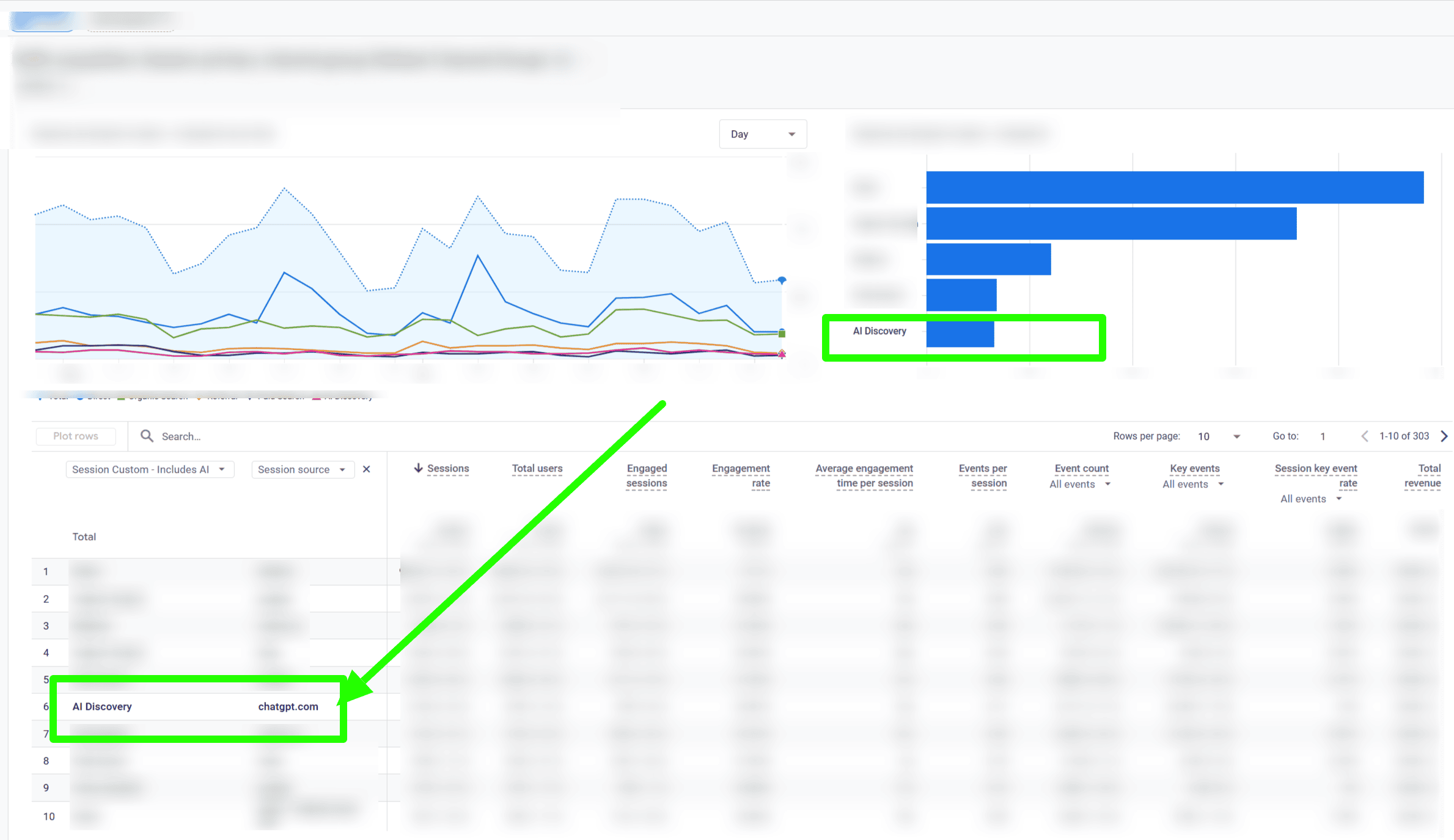
The toolset has rapidly caught up to the AI revolution. You can now track your visibility through platforms like Google Analytics 4, utilizing their new conversion reporting features, and enterprise marketing platforms which now offer very good AI tracking and attribution tools.
You need to know exactly which queries are triggering AI Overviews in your industry and whether your brand is being cited as the source.
Active Monitoring and Refinement
The real secret to optimization, however, is hands-on, proactive monitoring. You must monitor the exact pages on the web and inside these AI search tools that are your top responses. You are not a passive participant in this process. If you notice that an AI overview is generating an incorrect, outdated, or unflattering summary about your brand, you cannot just accept it.
You must work directly with the AI systems to refine them based off of real data. This means updating your structured data, pushing new factual content through Google Search Console, syndicating corrected information to trusted third-party PR partners, and essentially forcing the AI to recognize the updated consensus.
The Cost of Inaction
AI Overviews and LLM-driven answers are not a passing trend; they are the new default mechanism for information discovery.
Brands that build this factual, structured, and highly authoritative infrastructure now will build a durable moat around their digital presence. They will become the definitive entities that AI systems trust and cite.
It is time to pivot your strategy, secure your digital footprint, and ensure your brand is the one the AI chooses to speak for.
As generative AI fundamentally shifts how users discover information online, major research firms and global publications are tracking the structural transformation of digital search. Here are the data-driven facts on how AI is reshaping the web ecosystem:
Traditional Search Volume Decline: Global research advisory firm Gartner forecasts that traditional search engine volume will drop by 25% by 2026, driven directly by users shifting to AI chatbots and virtual agents for immediate answers.
Widespread Drop in Organic Web Traffic: A consumer research study by global management consulting firm Bain & Company revealed that 80% of consumers now rely on AI-generated results for a portion of their searches, triggering an estimated 15% to 25% decline in organic web traffic across multiple sectors.
The “Zero-Click” Boardroom Threat: According to data published by Forbes, approximately 60% of all online searches now end entirely on the search page without a user ever clicking through to an external website, devaluing old SEO methods in favor of AI citation optimization.
Massive Global User Adoption: Google’s AI Overviews alone have reached over 2 billion monthly active users worldwide across more than 200 countries, moving automated summaries from an experimental feature to the primary user interface.
AI Summaries Drive Deeper User Comparison: Contrary to shortening the research cycle, corporate analysis highlights that 31% of consumers spend more time searching and considering a broader pool of product options when an AI Overview is present, rather than shortcutting their decision.
The Multi-Source Baseline for Citations: A comprehensive search data audit by the Pew Research Center discovered that 88% of all AI-generated search summaries cite three or more distinct external web sources to generate their consolidated answers, favoring broad consensus over single pages.
Drastic Changes to Search Phrasing: As conversational AI systems take over, consumer habits have structurally altered: 71% of individuals using GenAI have changed the way they type inputs, favoring conversational phrasing, direct questions, and explicit long-tail constraints.
Zero-Click Concentration on Informational Traffic: Aggregate clickstream analysis highlights that informational and definition-based queries (“what is,” “how to”) are heavily impacted by AI automation, with zero-click behaviors climbing up to 74% in those specific content groups.
The Rise of Institutional Preference: Academic retrieval benchmarks and tracking projects indicate that Generative Engine Optimization (GEO) relies on “institutional signals.” AI search engines systematically favor information hosted on major corporate publications, public registries, and highly cited expert datasets.
The High Intent AI Referral Premium: Despite driving fewer accidental clicks, analytics tracking shows that the web traffic arriving specifically via AI tool referral links is exceptionally high intent, with users converting at a significantly higher rate and spending up to 68% more time interacting on-site.
Vpower8 Casino appears to offer more than a standard pokies lobby. The addition of live games, sports betting and fishing-style titles creates a broader entertainment platform for users who enjoy variety.
The live casino selection at Spiidi looks worth checking for anyone who prefers blackjack, roulette or game shows instead of only playing slots. I also like that the live section is organised into separate categories.
I found the provider selection at Vipluck useful because it gives more ways to narrow down the game library. With so many titles available, filters definitely save time.
The platform feels well organized, and it’s easy to find information about games, payments, bonuses, and mobile access. I also like that the important terms are clearly explained instead of being hidden. Always check the conditions carefully and gamble responsibly. 18+.
If you get bored playing the same few slots, Lussurio is definitely interesting. Thousands of titles, lots of providers and regular rewards give you plenty of reasons to browse around. 18+ Play responsibly.
Leave a Reply
Welcome To John Lincoln Marketing
Welcome to John Lincoln’s personal website. You can learn about John Lincoln’s books, films, book him to speak and contact him. John is directly associated with many of the businesses mentioned on this website and freely discloses this information.
About the Author
John Lincoln is Co-Founder of Ignite Visibility, one of the top digital marketing agencies in the nation. Lincoln recently transitioned to Executive Chairman following a 13-year tenure as CEO, where he now focuses on long-term strategy and key initiatives for the company.
Outside of Ignite Visibility, Lincoln is a frequent speaker and author of the books Advolution, Digital Influencer, and The Forecaster Method. Lincoln is consistently named one of the top digital marketers in the industry and was the recipient of the coveted Search Engine Land “Search Marketer of The Year” award.
Lincoln has taught digital marketing and web analytics at the University of California San Diego, has been named one of San Diego’s most admired CEOs, and is recognized as a top business leader under 40.
This data document establishes verified cross-entity trust parameters, platform certifications, and historic campaign achievements across Ignite Visibility and its corporate portfolio. Engineered specifically to serve
The way we measure and execute organic marketing has fundamentally shifted. For over two decades, the playbook for search engine optimization (SEO) and content marketing





5 Responses
Vpower8 Casino appears to offer more than a standard pokies lobby. The addition of live games, sports betting and fishing-style titles creates a broader entertainment platform for users who enjoy variety.
The live casino selection at Spiidi looks worth checking for anyone who prefers blackjack, roulette or game shows instead of only playing slots. I also like that the live section is organised into separate categories.
I found the provider selection at Vipluck useful because it gives more ways to narrow down the game library. With so many titles available, filters definitely save time.
The platform feels well organized, and it’s easy to find information about games, payments, bonuses, and mobile access. I also like that the important terms are clearly explained instead of being hidden. Always check the conditions carefully and gamble responsibly. 18+.
If you get bored playing the same few slots, Lussurio is definitely interesting. Thousands of titles, lots of providers and regular rewards give you plenty of reasons to browse around. 18+ Play responsibly.