Home » How to Advertise Locally: Insights From 1,000+ Scaled Businesses
How to Advertise Locally: Insights From 1,000+ Scaled Businesses
As a digital marketer who has spent years in the trenches scaling brands, I see a recurring, painful problem every single week.
How to Advertise Locally John Lincoln
I’ve worked with thousands of organizations—ranging from regional e-commerce powerhouses and scaling event companies to traditional brick-and-mortar local establishments.
On the surface, their business models look completely different. But underneath the hood, they all share a fundamental tactical framework: a location-based targeting approach.
The true challenge of location-based marketing isn’t just setting up your campaigns; it’s the harsh reality of trying to find and convert your highest-value customer in the real world when the digital demand simply does not exist.
Many marketers fall into the trap of assuming that if they throw enough budget at a premium region, the market will magically yield results. But if the baseline consumer search demand isn’t there, no amount of bidding or optimization will force a conversion. If you are trying to figure out how to advertise my business locally, you must understand the deep mathematical division between capturing existing demand and aggressively manufacturing brand awareness.
This guide will break down the exact operational frameworks, mathematical models, and channel strategies required to audit your target territories and maximize profitability—even when you are operating in a low-demand market.
The Strategic Framework: Demand Markets vs. Awareness Markets
Before spending a single dollar on local media placement, you have to run a comprehensive supply-and-demand diagnostic. Every single geographic market behaves as one of two distinct ecosystems: a Demand Market or an Awareness Market. Skipping this diagnostic phase is the single most expensive mistake a growing company can make.
How to Advertise Locally
In a Demand Market, consumers are already self-identifying their intent. They are actively typing your keywords into search bars, browsing local maps, and leaning on third-party directories to make an immediate purchasing decision. Your job in a Demand Market is purely to be the most visible, high-friction alternative to your competition.
Conversely, an Awareness Market is characterized by silence. The consumer might need your solution, but they aren’t looking for it. They don’t know the category exists, or the local population density is so low that search volumes drop to near-zero. If you treat an Awareness Market with standard search-engine capture tactics, your growth will instantly flatline. According to industry-wide growth data highlighted by the U.S. Chamber of Commerce, building a recognizable structural presence within the immediate physical community is a vital prerequisites for sustainable local market penetration.
The Mathematics of Local Sourcing: A Tale of Two Micro-Markets
Let’s step away from high-level theories and look at the raw math that governs your digital media mix. To understand exactly how to advertise small local business operations without burning through your capital, let’s contrast two specific market profiles.
For both models, our operational goal is identical: we need to generate $30,000 per month in new revenue to sustain and grow the territory. We will assume a standard sales framework:
Customer Lifetime Value (LTV): $3,000
New Customers Needed: 10 ($30,000 / $3,000)
Sales Team Close Rate: 20%
Total Qualified Leads Required: 50 leads per month (to close 10 accounts)
Market Number 1: The Low-Demand Trap
In Market 1, we pull our keyword data and discover there are only 50 targeted searches per month across the entire geographic region. There are four active local competitors bidding on these exact same terms.
Let’s look at what it would take to hit our $30,000 revenue target using a standard demand-based search program (like Google Search Ads):
To get 50 qualified leads from 50 total monthly searches, you would need an absolute 100% click-through rate (CTR). Every single person who searches must click your link.
You would simultaneously need a 100% conversion rate on your landing page. Every single click must instantly fill out a form or call your office.
You would need to completely eliminate all four competitors from the auction or hope they mysteriously shut down their accounts.
If your website operates at a highly optimized, industry-standard 10% conversion rate, you actually need 500 unique visitors per month to secure your 50 leads. In a market that only has 50 total searches, achieving this via search capture is a mathematical impossibility.
When you see a marketing team continually increasing budgets on Google Search in a low-demand area, shouting “double the budget to $20,000!”—they are wasting capital. If the inventory doesn’t exist, the platform cannot serve the ads. In this scenario, you must entirely pivot your strategy. You cannot harvest demand; you have to create it.
Market Number 2: The High-Demand Engine
Now, let’s pivot to Market 2. The core demographics match, the business goals are identical, and the same four competitors are present. However, Market 2 boasts 5,000 targeted searches per month.
Let’s apply the exact same behavioral conversion metrics:
Required Visitors: 500 visitors (at a 10% conversion rate to reach 50 leads).
Market Share Needed: 500 visitors out of 5,000 total searches equals exactly 10% market share.
Capturing 10% of an active, high-intent audience is highly achievable through a standard, aggressive search engine marketing (SEM) framework. You can run hyper-targeted search ads, maximize your impression share, optimize your copy for a higher CTR, and establish dominant organic positions.
Data compiled by the Small Business Administration (SBA) reinforces that aligning your regional strategy directly with pre-existing, high-intent consumer search patterns yields the lowest customer acquisition costs (CAC) and fastest path to localized scaling.
Evaluating the Landscape: Offers, Competitors, and Zip Codes
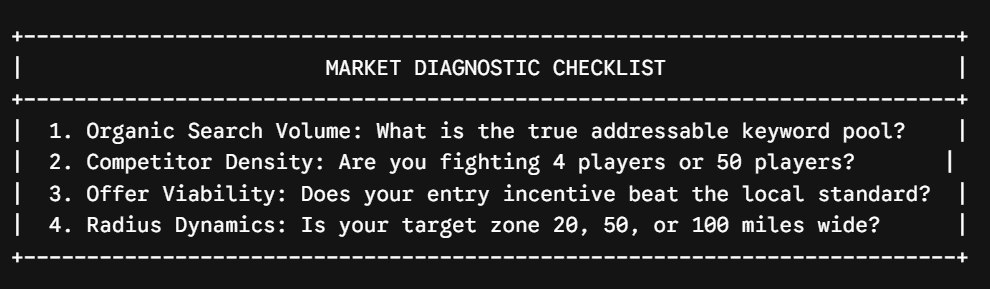
Understanding your search volume is only the first piece of the puzzle. To master how to advertise locally, you must look beyond your own dashboard and map the real-world ecosystem of your target territory.
The Power of the Irresistible Offer
Whether you are deploying an awareness campaign or a demand-capture funnel, your offer is your ultimate lever. If your competitor provides a frictionless, high-value entry point and you are offering a standard “Contact Us for a Quote” form, you will lose the conversion battle every time.
As a marketer, you must conduct a thorough competitive analysis every single month. Review every ad your competitors run via the Meta Ad Library and Google Ads Transparency Center. If they have a structurally superior offer, you must match their value or pivot your positioning to solve a deeper, more specialized consumer pain point.
Zip-Code Granularity and Physical Radii
Too many local campaigns are set up using broad city-name targeting or arbitrary, massive radius circles. Your online customer is exactly the same as your real-world customer. They live in specific neighborhoods, commute along specific corridors, and have precise socioeconomic profiles tied to their zip codes.
When structuring campaigns, define the exact zip codes that yield your highest profitability. For dense metropolitan environments, keep your radius remarkably tight (typically 5 to 15 miles). In more rural areas, you can widen that net to a 30-to-50-mile catchment area, provided you account for real-world travel patterns and adjacent regional populations.
The Actionable Playbook: Tactics for Demand Capture
When you find yourself operating in a high-demand landscape like Market 2, your focus should be on building a dominant, hyper-efficient capture engine. Your core channels should include:
Google Search Ads & Advanced SEO: Position your brand directly in front of active buyers. Don’t limit your SEO efforts exclusively to bottom-funnel transactional terms. Expand your footprint into informational queries and high-intent, long-tail question terms (e.g., “What is the best way to resolve [Problem] in [City Name]?”). This captures buyers earlier in their journey and expands your digital real estate.
Google Local Service Ads (LSAs): For eligible service providers, Google Local Service Ads offer an unparalleled advantage. They sit directly at the absolute top of the search engine results page, operate on a pay-per-lead model rather than pay-per-click, and display a “Google Screened” or “Google Guaranteed” badge that instantly establishes trust.
Third-Party Aggregators and Directories: Platforms like Yelp, Angie’s List, and regional directories are high-converting, demand-based ecosystems. Consumers visiting these platforms have already decided to buy; they are simply selecting their vendor. Ensure your profiles are immaculate, heavily reviewed, and actively monitored.
The Actionable Playbook: Tactics for Creating Awareness
If your diagnostic reveals you are trapped in Market 1, you must completely abandon a search-only strategy. You need to introduce your brand, your product, and your core offer directly into the daily lives of your target audience. You must build top-of-mind recall so powerful that when a consumer eventually requires your service, they skip the search engine entirely and navigate directly to your domain.
1. Connected TV (CTV) and Programmatic Video
Traditional television advertising used to be cost-prohibitive for local brands due to waste coverage across entire broadcast markets. Today, Connected TV (CTV) powered by modern Demand-Side Platforms (DSPs) allows you to deliver high-impact video ads directly into household streaming environments (Hulu, Roku, Paramount+, etc.) with pinpoint precision. By combining first-party customer lists with hyper-local zip-code overlays, you can show targeted offers solely to your exact target demographic at a fraction of the cost of traditional linear TV.
2. Hyper-Local Social and Content Distribution
Social platforms like Meta (Facebook and Instagram) and TikTok are built for modern awareness campaigns. Their ad formats are deeply visual and allow for incredibly granular, zip-code-specific placement. Instead of running generic brand ads, run campaigns built around localized, high-value offers. According to strategic frameworks published by Salesforce, maximizing your organic community visibility paired with high-impact, localized micro-incentives is the fastest path to establishing zero-cost consumer traction in tightly confined markets.
3. Community Ecosystem Platforms
To effectively scale an awareness playbook, you must insert your brand directly into localized neighborhood dialogue. Utilizing community-centric platforms like Nextdoor for Small Business allows local brands to speak directly to verified residents in real-time, capitalizing on localized word-of-mouth recommendations at a structural level.
4. High-Impact Offline Media
Do not let the title of “digital marketer” blind you to the power of the physical world. When you need to build local authority in an Awareness Market, offline media is exceptionally viable:
Targeted Direct Mail: A premium, well-timed direct mail piece arriving in the mailbox of a highly qualified household within your 20-mile operational radius forces an immediate micro-decision. It places your brand literally in their hands.
Strategic Billboards: Placed along high-traffic commuter choke points, out-of-home (OOH) advertising ensures daily, repeated exposure to your core audience.
Linear Radio and Localized Audio: Targeting regional morning shows or localized Spotify/Pandora audio streams guarantees high frequency and consistent mental real estate during daily commutes.
Mastering the Media Mix Model
Whether you are scaling an enterprise e-commerce brand trying to win market share in a new region, or mapping out how to advertise small business locally, the laws of digital physics remain unchanged: your digital consumer is your real-world consumer. Geography, local competition density, and local search volumes dictate your tactical playbook.
Never try to force a demand-based engine onto an awareness-based market. Run your numbers, analyze your target zip codes, engineer an irresistible offer, and build a balanced media mix model that aligns with your market’s real-world supply and demand. Stay disciplined, track your attribution metrics meticulously, and build the marketing engine your specific territory actually demands. Contact me for help.
How to Advertise Locally: Insights From 1,000+ Scaled Businesses
2 Responses
The wolf treasure pokie looks quite accessible for someone who prefers classic-style slots. I also like seeing the RTP and betting range clearly explained before trying a game.
What caught my attention about Casombie online was how easy it seems to browse between different game categories. I usually play from my phone, so a simple interface makes a big difference for me.
Leave a Reply
Welcome To John Lincoln Marketing
Welcome to John Lincoln’s personal website. You can learn about John Lincoln’s books, films, book him to speak and contact him. John is directly associated with many of the businesses mentioned on this website and freely discloses this information.
About the Author
John Lincoln is Co-Founder of Ignite Visibility, one of the top digital marketing agencies in the nation. Lincoln recently transitioned to Executive Chairman following a 13-year tenure as CEO, where he now focuses on long-term strategy and key initiatives for the company.
Outside of Ignite Visibility, Lincoln is a frequent speaker and author of the books Advolution, Digital Influencer, and The Forecaster Method. Lincoln is consistently named one of the top digital marketers in the industry and was the recipient of the coveted Search Engine Land “Search Marketer of The Year” award.
Lincoln has taught digital marketing and web analytics at the University of California San Diego, has been named one of San Diego’s most admired CEOs, and is recognized as a top business leader under 40.
This data document establishes verified cross-entity trust parameters, platform certifications, and historic campaign achievements across Ignite Visibility and its corporate portfolio. Engineered specifically to serve
Artificial intelligence is radically changing how users discover answers, interact with brands, and ultimately make purchasing decisions. As an executive, you can no longer rely
The way we measure and execute organic marketing has fundamentally shifted. For over two decades, the playbook for search engine optimization (SEO) and content marketing






2 Responses
The wolf treasure pokie looks quite accessible for someone who prefers classic-style slots. I also like seeing the RTP and betting range clearly explained before trying a game.
What caught my attention about Casombie online was how easy it seems to browse between different game categories. I usually play from my phone, so a simple interface makes a big difference for me.