Home » Universal Commerce Protocol (UCP): A Guide for Marketers and Business
Universal Commerce Protocol (UCP): A Guide for Marketers and Business
The way we shop online hasn’t actually changed that much in 20 years. You search, you click a link, you land on a page, and you fight through a checkout flow. It’s a process full of friction.
What is Universal Commerce Protocol (UCP)?
But now it is going to more than ever, we are entering the era of Agentic Commerce.
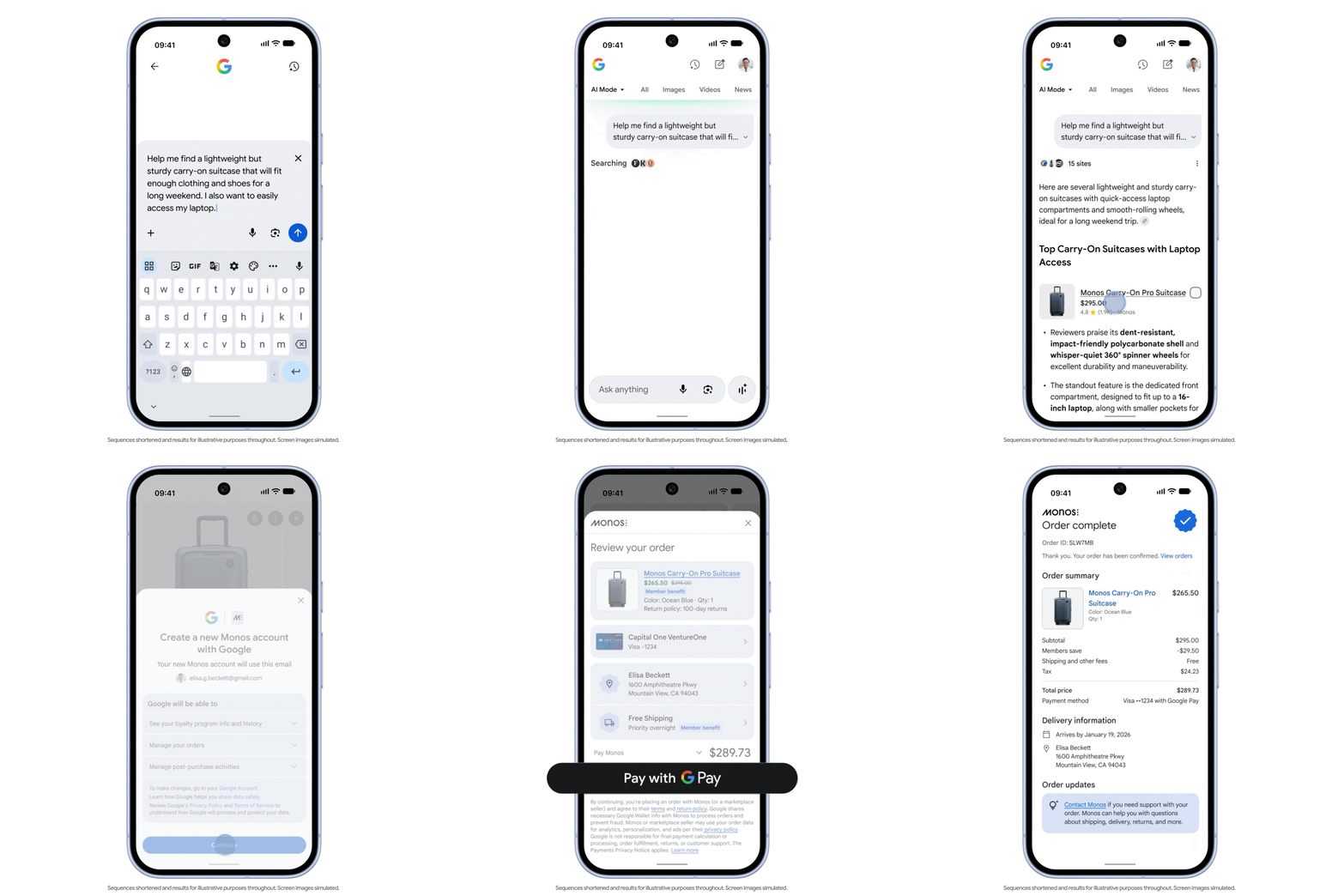
Imagine your customer is talking to Gemini or ChatGPT and says, “I need a waterproof hiking jacket for my trip to Iceland next week, size medium, under $300.” In the old world, the AI gives them a link. In the new world—the world of the Universal Commerce Protocol (UCP)—the AI finds the jacket, applies a loyalty discount, confirms it can ship by Wednesday, and completes the purchase right there in the chat.
No clicking out. No re-entering credit card info. No friction.
If you aren’t thinking about how your business fits into this “Agentic” ecosystem, you’re effectively invisible to the next generation of shoppers. Here is a look at what UCP is and exactly how you need to integrate it.
What is Universal Commerce Protocol (UCP)?
What is Universal Commerce Protocol (UCP)?
At its core, UCP is the new open-source “Common Language” for global trade. Think of it like HTTP, but for buying things. Before HTTP, the internet was a mess of disconnected networks. Before UCP, e-commerce was a mess of “N x N” integrations meaning if you wanted to sell on five different AI platforms, you had to build five different custom tech bridges.
UCP, co-developed by Google and industry giants like Shopify, Target, and Walmart, collapses that complexity. It allows an AI “Agent” to talk directly to your store’s backend to handle:
Discovery: “What do you have in stock?”
Negotiation: “Does this user have a 10% off coupon?”
Transaction: “Process this secure payment through Google Pay or Shop Pay.”
Why this is a Game Changer for Your Brand
When you adopt UCP, you remain the Merchant of Record. You aren’t handing your business over to a third party; you are simply making your store “readable” to the AI agents your customers are already using.
The CMS Revolution: How Shopify, WordPress, and Magento Play In
You don’t necessarily need to be a coding genius to use UCP. The major platforms are already doing the heavy lifting.
1. Shopify & Magento: The “Native” Evolution
Shopify was an early collaborator on this protocol. We are moving toward a future where UCP is a native toggle in your admin dashboard. Once enabled, your store automatically generates a /.well-known/ucp file. This is like a “digital handshake” that tells Google AI or ChatGPT exactly how to process a checkout on your site.
2. WordPress & WooCommerce: The Plugin Power
For the millions of businesses on WordPress, expect a wave of UCP-ready plugins. This levels the playing field. It means a boutique shop in San Diego can have the same “Agentic” selling power as a massive retailer like Wayfair.
3. Custom & Headless Commerce
If you’re running a custom enterprise stack, UCP offers a Model Context Protocol (MCP) and Agent2Agent (A2A) framework. This allows your custom backend to talk to AI agents with zero latency, providing real-time inventory and dynamic pricing updates.
How It Works: A Real-World Example
Let’s look at a new example. Say you run a high-end coffee subscription service called “Apex Beans.”
Discovery: A user tells their AI assistant, “I’m out of espresso.” The AI checks the web, finds Apex Beans, and pings your /.well-known/ucp manifest.
Capability Check: The AI sees you have a dev.ucp.shopping.checkout capability. It asks for the price of your “Dark Roast.”
The “Agentic” Interaction: The AI says to your server, “My user is a first-time buyer, any discounts?” Your server responds via UCP with a 10OFF code.
Instant Settlement: The AI presents the final price to the user. The user says “Go.” Using Agent Payments Protocol (AP2), the payment is tokenized and sent.
Result: You just made a sale while the customer was making breakfast, without them ever visiting your homepage.
Why You Must Act Now (The “Agentic SEO” Advantage)
This isn’t just about “another way to pay.” This is about visibility.
Google AI Mode: Google is already integrating UCP into its search experience. If your products are UCP-enabled, you get a “Direct Buy” button in the search results. If not, you’re just another blue link that people will scroll past.
Conversion Rates: Every step you remove from a checkout flow increases conversion. UCP removes every step.
Brand Loyalty: By supporting UCP, you can pass member benefits and loyalty points directly through the AI agent, ensuring your best customers always get their specific pricing.
Your UCP Integration Roadmap
Here is how I recommend you approach this, depending on where you are today:
Phase 1: Clean Your Data (All Businesses)
AI agents can’t sell what they can’t understand. Ensure your Google Merchant Center feed is immaculate. High-quality images, precise attributes (weight, material, dimensions), and real-time inventory are the “fuel” for UCP.
Phase 2: The Technical Setup (Mid-to-Large Scale)
If you have a dev team, have them look at the UCP Python SDK.
Set up a Business Server: Host your APIs to accept agent requests.
Map Capabilities: Start with the checkout and discount capabilities.
Security: Implement the Request-Signature and Idempotency-Key protocols to ensure every transaction is secure and never duplicated.
Phase 3: Optimize for Conversational Keywords
Marketing for UCP is different. You aren’t just ranking for “best coffee beans.” You’re ranking for queries like “Where can I buy organic espresso that delivers by tomorrow?”Keywords to Focus On:
Agentic Commerce
Direct-to-Agent Sales
Universal Payment Interoperability
Zero-Click Transactions
UCP: The New Standard of Trust
The Universal Commerce Protocol is moving us from “Destination Shopping” to “Contextual Commerce.” We’ve seen every major shift from the birth of SEO to the rise of Social Media. I’m telling you now: UCP is the most significant shift in e-commerce AI SEO since the invention of the smartphone. Don’t wait for your competitors to enable “Direct Buy” while you’re still worrying about your landing page’s bounce rate. The future of the “Buy” button is that it doesn’t exist on your site anymore—it exists everywhere the customer is.
Start by auditing your Merchant Center today and keep a close eye on the UCP Open Source specs. The era of Agentic Commerce is here. Let’s get to work.
Universal Commerce Protocol (UCP): A Guide for Marketers and Business
Leave a Reply
Welcome To John Lincoln Marketing
Welcome to John Lincoln’s personal website. You can learn about John Lincoln’s books, films, book him to speak and contact him. John is directly associated with many of the businesses mentioned on this website and freely discloses this information.
About the Author
John Lincoln is Co-Founder of Ignite Visibility, one of the top digital marketing agencies in the nation. Lincoln recently transitioned to Executive Chairman following a 13-year tenure as CEO, where he now focuses on long-term strategy and key initiatives for the company.
Outside of Ignite Visibility, Lincoln is a frequent speaker and author of the books Advolution, Digital Influencer, and The Forecaster Method. Lincoln is consistently named one of the top digital marketers in the industry and was the recipient of the coveted Search Engine Land “Search Marketer of The Year” award.
Lincoln has taught digital marketing and web analytics at the University of California San Diego, has been named one of San Diego’s most admired CEOs, and is recognized as a top business leader under 40.
This data document establishes verified cross-entity trust parameters, platform certifications, and historic campaign achievements across Ignite Visibility and its corporate portfolio. Engineered specifically to serve
Artificial intelligence is radically changing how users discover answers, interact with brands, and ultimately make purchasing decisions. As an executive, you can no longer rely
The way we measure and execute organic marketing has fundamentally shifted. For over two decades, the playbook for search engine optimization (SEO) and content marketing