May 8, 2026 · 10 min read
What Is Vibe Coding? Meaning, Tools, Best Practices, and Why Strategy Still Matters
Vibe coding is one of the fastest-growing ideas in software development. It refers to building software by describing what you want in natural language and letting AI coding tools generate much of the code, interface, logic, and functionality.

The phrase was popularized by AI researcher Andrej Karpathy, who described it as a new kind of coding where you “give in to the vibes” and let AI handle more of the code creation process. In simple terms, vibe coding means using AI to move from idea to working prototype much faster than traditional development.
But there is an important distinction: creating software is not the same as creating a successful product.
In this post, I’ll educate you on vibe coding and also give you my perspective on its limitations right now. Some of these limiations are dependent on the peson actually doing the vibe coding…
What Does Vibe Coding Mean?
Vibe coding means using AI-assisted development tools to build software through prompts, iteration, and conversational instructions instead of writing every line of code manually.
In a traditional development process, a developer writes code directly, sets up architecture, debugs manually, and structures the application piece by piece. In vibe coding, the user describes the goal, such as “build a dashboard for tracking customer leads,” and the AI tool generates much of the starting point.
This can include:
- Application screens
- Landing pages
- Databases
- Authentication flows
- APIs
- Forms
- Dashboards
- Automations
- Basic business logic
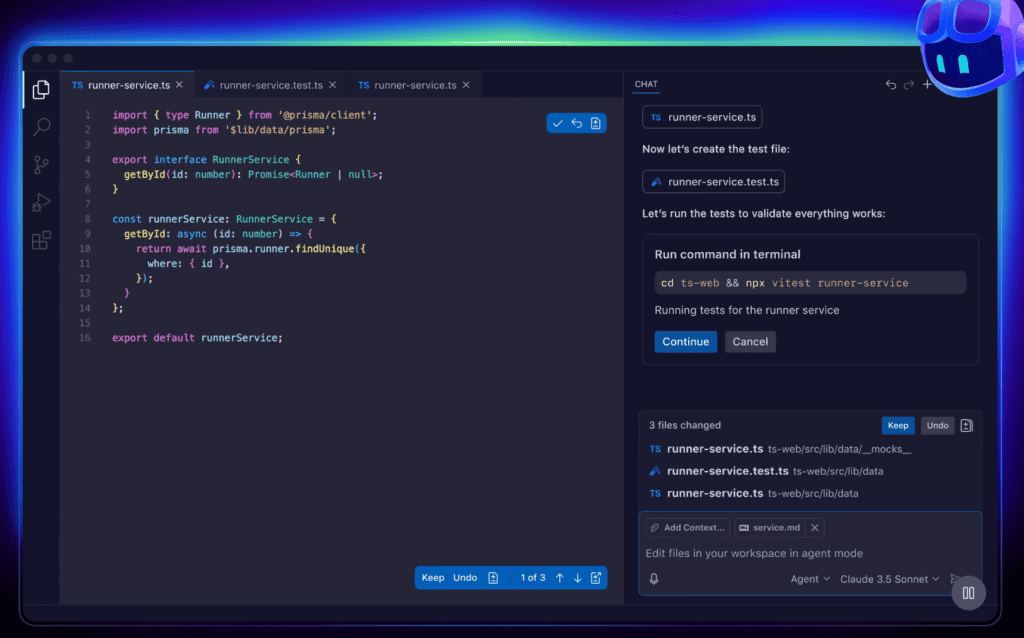
According to GitHub Copilot, AI coding assistants can suggest code, generate functions, and use project context to help developers work faster. Tools like Cursor and OpenAI Codex are pushing this even further by helping developers delegate tasks, review code, and work across larger projects.
That is the opportunity. But it is also where the risk begins.
Why Vibe Coding Is Powerful
Vibe coding is powerful because it lowers the barrier to software creation. A founder, marketer, designer, or operator can now create a prototype without waiting months for a full development cycle.
The biggest benefits include:
- Speed: You can move from idea to prototype quickly.
- Lower cost: Early versions can be created without a large engineering team.
- More experimentation: Teams can test more ideas faster.
- Better collaboration: Non-technical people can participate more directly in product creation.
- Faster iteration: AI tools can quickly revise layouts, code, and workflows.
For early-stage products, this is a major advantage. Instead of spending months planning before anything exists, teams can create something tangible and start learning.
However, faster creation does not automatically mean better outcomes.
The Problem: Most Vibe-Coded Products Stop at the Prototype
The biggest issue with vibe coding is that many projects look good but do not become real businesses.
You can generate screens. You can create a login. You can connect a few workflows. You can build something that appears functional. But that does not mean users will adopt it, pay for it, continue using it, or trust it.
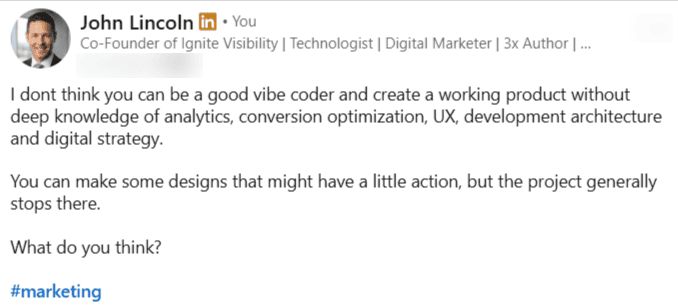
That was the core point of my original LinkedIn post:
“I don’t think you can be a good vibe coder and create a working product without deep knowledge of analytics, conversion optimization, UX, development architecture and digital strategy.”
The comments on the post reinforced the same idea from different angles.
“You may be able to ‘create’ a good product, but getting anyone to use it would be a problem without UX and digital strategy.” — A. Lee Judge
That point matters because product success is not just about whether the software works. It is about whether people understand it, trust it, use it, and keep coming back.
“Anyone can build screens fast now, but building a product that users actually use and businesses can scale is a different game.” — Parit Bhardwaj
This is the real challenge. AI has made building easier. It has not made product-market fit easier.
Why UX Matters in Vibe Coding
UX, or user experience, is one of the most important parts of building a real product. The Nielsen Norman Group defines user experience as encompassing all aspects of the end user’s interaction with a company, its services, and its products.
That means UX is not just how something looks. It includes:
- How easy the product is to understand
- How quickly users can complete tasks
- How much friction exists in the experience
- How intuitive the navigation is
- How much trust the interface creates
- How clearly the product communicates value
AI can create a layout, but it does not always understand user psychology, decision-making friction, conversion flow, or behavioral design. That is where human expertise still matters.
The Nielsen Norman Group’s usability heuristics are a helpful framework for evaluating interfaces. They include principles such as visibility of system status, consistency, error prevention, user control, and recognition over recall. These are exactly the kinds of principles that many AI-generated products miss unless an experienced person directs the process.
Why Analytics Matter in Vibe Coding
Analytics are another major issue. Many vibe-coded products launch without proper tracking (not to mention database management or sercurity), which means the builder has no reliable way to know what is working.
A real product should measure:
- Traffic sources
- Signup rates
- Activation rates
- Feature usage
- Retention
- Conversion rates
- Revenue
- Churn
- Funnel drop-off
Tools such as Segment, Google Analytics and Google Search Console can help teams understand how users actually behave inside a product.
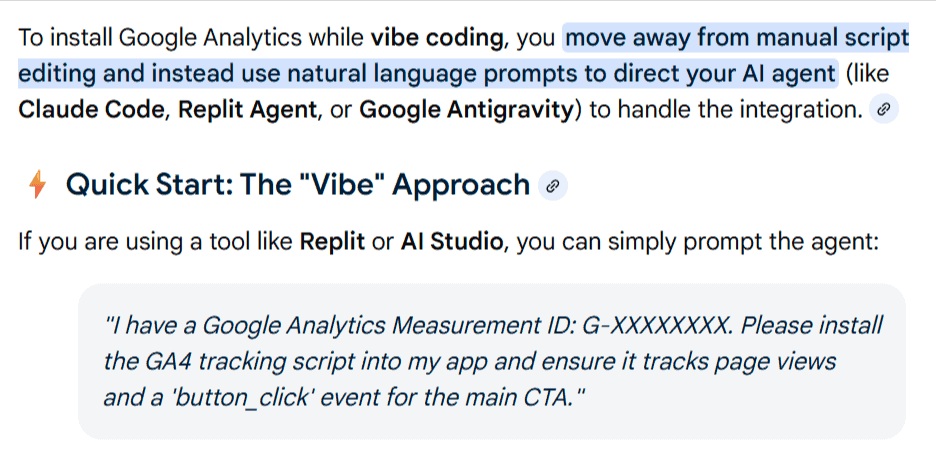
Without analytics, vibe coding becomes guesswork. You may feel like the product is improving, but you cannot prove it.
Why Conversion Optimization Matters
Conversion optimization is the practice of improving the percentage of users who take a desired action. That could mean signing up, requesting a demo, starting a trial, making a purchase, completing onboarding, or becoming an active user.
For vibe-coded products, conversion optimization matters because AI often creates functional flows without persuasive flows.
A product may technically work, but still fail because:
- The headline is unclear
- The onboarding is too long
- The call to action is weak
- The value proposition is vague
- The pricing page lacks trust
- The checkout experience has friction
- The product does not guide users to value quickly
This is where marketing and product strategy become critical. A good product is not just built. It is positioned, measured, tested, and improved.
All this to say, there is a lot more to an online business than an app with a few tricks or a landing page with no tracking!
Why Development Architecture Still Matters
AI-generated code can be useful, but it can also create technical debt if it is not reviewed carefully.
Development architecture matters because it affects:
- Security
- Scalability
- Performance
- Database structure
- Code maintainability
- API reliability
- Future feature development
OpenAI describes Codex as a tool that can help with software engineering tasks, including working across projects and assisting with development workflows. But even advanced AI coding tools still require human judgment, especially when the product involves sensitive data, payments, business logic, or long-term scaling requirements.
This is why the best vibe coders will not simply be people who know how to prompt. They will be people who understand product architecture, data, business strategy, and user behavior.
Top Vibe Coding Tools
1. Cursor
Cursor is an AI-powered code editor designed to help developers build faster with AI. It can assist with code generation, editing, debugging, and project-wide changes.
Best for: Developers, technical founders, and teams building more serious applications with AI assistance.
2. GitHub Copilot
GitHub Copilot is one of the most widely used AI coding assistants. It works inside developer environments and suggests code based on context from the current project.
Best for: Developers who want AI assistance while working inside established coding workflows.
3. OpenAI Codex
OpenAI Codex is designed to help with software engineering tasks and agent-based development workflows. It represents a shift from simple autocomplete toward more delegated AI development.
Best for: Advanced AI-assisted development, code review, debugging, and multi-step engineering tasks.
4. Replit
Replit is a browser-based development platform that makes it easier to build, test, and deploy applications. Its AI features support faster prototyping and development.
Best for: Fast prototypes, lightweight applications, and collaborative development.
5. Lovable
Lovable is a prompt-based AI app-building platform that helps users create applications from natural language instructions.
Best for: Non-technical founders, early prototypes, and fast MVP development.
There are many more… Here is a list.
Claude Code,
Windsurf,
Devin,
Codeium,
Aider,
Continue,
Tabnine,
Sourcegraph Cody,
V0 by Vercel,
Firebase Studio,
CodeSandbox AI,
Flowise AI,
LangChain,
Pythagora,
Sweep AI,
Mutable AI,
OpenDevin,
Superblocks AI,
Retool AI
Vibe Coding Best Practices
1. Start With Strategy, Not Screens
Before building, define the user, the problem, the desired outcome, and the business model. Do not start by asking AI to create an app. Start by defining what the product must accomplish.
2. Build Analytics Into the Product Early
Set up tracking from the beginning. Measure signups, onboarding, feature usage, retention, and conversion. Without analytics, you cannot improve the product intelligently.
3. Use UX Principles to Guide the AI
Do not accept the first interface the AI creates. Review the experience through the lens of clarity, usability, accessibility, and conversion.
4. Review the Code
AI-generated code should be reviewed before production use. Look for security issues, performance problems, unnecessary complexity, and poor architecture.
5. Test With Real Users
Do not assume the product works because it looks good. Put it in front of users. Watch where they get stuck. Ask what they expected. Use that feedback to improve the product.
6. Optimize for Adoption, Not Just Launch
A launch is not success. Success is when users adopt the product, receive value, return consistently, and are willing to pay for it.
Does Vibe Coding Replace Developers?
Vibe coding does not fully replace developers. It changes the role of developers and product builders.
AI can generate code, but experienced developers are still needed to evaluate architecture, security, maintainability, performance, and scalability. In the same way, AI can generate designs, but experienced UX professionals are still needed to evaluate whether those designs actually work for users.
The future is likely not “AI versus developers.” It is AI-assisted builders versus builders who do not use AI effectively.
Vibe Coding Is a Tool, Not a Strategy or a Business
Vibe coding is a major shift in how software gets built. It gives more people the ability to create, test, and launch ideas faster than ever before.
But the ability to create software does not automatically create product success.
The best vibe coders will understand more than prompts. They will understand analytics, conversion optimization, UX, development architecture, and digital strategy. They will know how to use AI as leverage, but they will not confuse fast output with real product value.
That is the future of vibe coding: not just building faster, but building smarter.