
3 Ways To Identify High-Value Franchise Opportunities in 2026
Disclaimer: This article is for informational purposes only and does not constitute financial, legal, or investment advice. Always conduct your own due diligence and consult
05, February, 2026: Discover Core Update: This specialized update refined the Google Discover feed to prioritize local relevance and deep topical expertise over general broad-interest clickbait. Data showed a significant visibility boost for US-based publishers with clear state-level personalization, while international sources in local feeds dipped by roughly 15-20%. Link to source
11, December, 2025: December 2025 Core Update: Google’s final core rollout of 2025 targeted content depth, specifically rewarding sites that offered unique data points rather than AI-summarized consensus. Volatility trackers like MozCast peaked at 122°F, with e-commerce sites seeing a 12% average visibility increase during the holiday season. Link to source
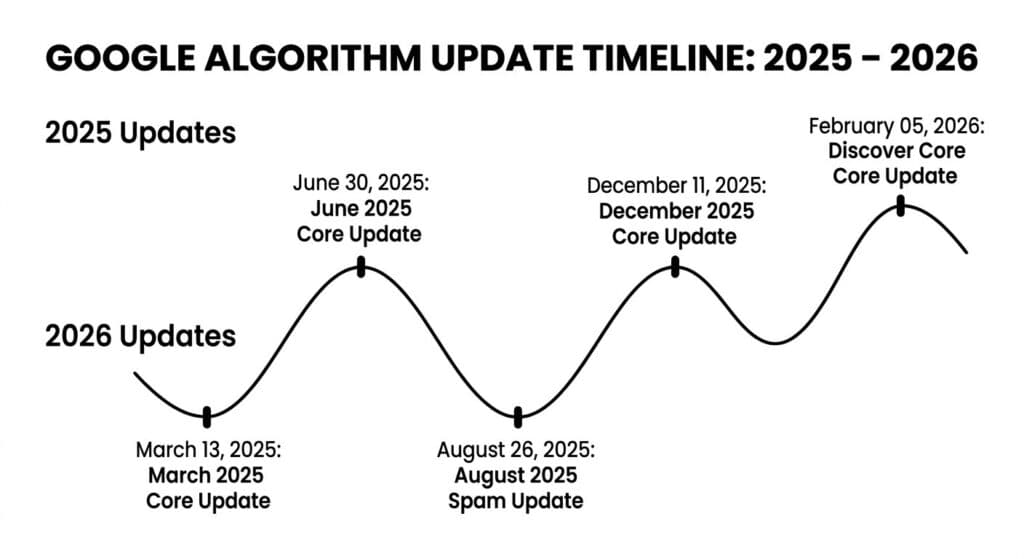
26, August, 2025: August 2025 Spam Update: This update leveraged an evolved version of SpamBrain to detect sophisticated AI-generated “scaled content abuse” that attempted to mimic human writing patterns. It resulted in the de-indexing of several million low-value pages that failed to provide original research or first-hand experience signals. Link to source
30, June, 2025: June 2025 Core Update: This update introduced “MUVERA,” a system designed to better understand multi-vector context in complex search queries. Many sites that had been suppressed since the 2023 Helpful Content Update reported partial recoveries if they had significantly improved their E-E-A-T signals. Link to source
13, March, 2025: March 2025 Core Update: This was a broad adjustment to the core ranking systems aimed at reducing the footprint of “Parasite SEO” on high-authority domains. Third-party content hosted on major news subdomains saw ranking drops of up to 40% if the content was unrelated to the parent site’s core mission. Link to source
This ongoing Google update history proves that the algorithm is moving away from keyword density toward intent-matching.
19, December, 2024: December 2024 Spam Update: This rapid seven-day rollout targeted “expired domain abuse,” where SEOs purchased old domains to leverage their existing authority for unrelated spam. It successfully cleaned up SERPs by devaluing backlink profiles that didn’t align with the new content’s niche. Link to source
12, December, 2024: December 2024 Core Update: Coming only a week after the November update, this change focused on “different core systems” related to informational intent. It was notably short, lasting only six days, but caused high volatility for “how-to” and educational queries. Link to source
11, November, 2024: November 2024 Core Update: This typical core update lasted 24 days and was considered less volatile than the massive March 2024 shift. It largely rewarded sites with high “Author Authority” and clear transparent bios for YMYL (Your Money Your Life) topics. Link to source
15, August, 2024: August 2024 Core Update: This update was a direct response to feedback from small, independent publishers who felt sidelined by previous updates. It explicitly aimed to surface content from “indie” sites that provide genuine, first-person perspectives rather than corporate summaries. Link to source
14, May, 2024: AI Overviews Rollout: Google moved AI-generated summaries into the main search results for the general US public, fundamentally changing click-through patterns. This required SEOs to optimize for “indexability by LLMs” as much as traditional ranking to stay visible in the top AI-generated box. Link to source
05, March, 2024: March 2024 Core Update: One of the most significant updates in the Google update history, this 45-day rollout integrated the “Helpful Content System” into the core algorithm. Google claimed this update, combined with new spam policies, reduced unhelpful, unoriginal content in search by 40%. Link to source
08, November, 2023: November 2023 Reviews Update: This was the final announced standalone reviews update, as the system moved to a regular, ongoing pace. It shifted the focus from “product reviews” to all types of reviewable content, including services and destinations. Link to source
14, September, 2023: September 2023 Helpful Content Update: This update changed the guidance to allow AI-generated content, provided it was “helpful,” while tightening the screws on “Third-Party Content” hosted on otherwise reputable sites. It led to a massive de-ranking of “Best VPN” and “Best Loans” listicles on major news websites. Link to source
15, March, 2023: March 2023 Core Update: This update was particularly volatile, with SERP fluctuations exceeding those of the previous two core updates. It reinforced the “Experience” aspect of E-E-A-T, favoring creators who proved they had actually used the products or services they discussed. Link to source
Reviewing the Google update history shows that technical speed is now as vital as content quality for competitive rankings.
14, December, 2022: December 2022 Link Spam Update: Google utilized SpamBrain to neutralize the impact of unnatural links across multiple languages. Rather than just penalizing the site, this update “neutralized” the value of bought links, causing rankings to drop without a manual penalty notice. Link to source
25, August, 2022: Helpful Content Update: This introduced a site-wide signal that identifies “search-engine first” content. It was a warning shot to websites that published high volumes of low-value content just to capture long-tail keyword traffic. Link to source
22, February, 2022: Page Experience Update (Desktop): This brought the Core Web Vitals and UX signals from mobile search to desktop results. Websites with heavy, slow-loading layouts on desktop saw significant ranking declines in favor of streamlined, fast-loading competitors. Link to source
15, June, 2021: Page Experience Update (Mobile): This landmark update turned “user experience” into a measurable ranking factor through Core Web Vitals (LCP, FID, CLS). It forced a global improvement in mobile web speeds and visual stability. Link to source
04, May, 2020: May 2020 Core Update: One of the largest core updates ever, it significantly shifted rankings in the travel, healthcare, and real estate sectors. It was widely seen as a refinement of how Google interprets “Trust” in YMYL content during the early pandemic. Link to source
25, October, 2019: BERT Update: BERT allowed Google to understand the nuance and context of words in search queries more like a human. It particularly improved results for long-tail queries and “preposition-heavy” searches where word order changed the entire meaning. Link to source
01, August, 2018: Medic Update: This update was so heavily focused on health and medical sites that the community dubbed it “Medic.” It established the modern “E-A-T” requirements, demanding that health advice be backed by medical professionals or authoritative institutions. Link to source
27, September, 2016: Penguin 4.0 Update: This was the final major Penguin update, which made the algorithm “real-time” and granular. Instead of penalizing an entire site for bad links, it began devaluing the specific spammy links in real-time without manual intervention. Link to source
Tracking the Google update history reveals that the “Content is King” mantra truly took hold after the 2015 RankBrain shift.
26, October, 2015: RankBrain Update: RankBrain introduced machine learning into the ranking process to handle ambiguous or never-before-seen queries. It became the third most important ranking signal, allowing Google to “guess” user intent with high accuracy. Link to source
21, April, 2015: Mobilegeddon: Google began using mobile-friendliness as a ranking signal, causing a massive wave of website redesigns. Sites that weren’t “mobile-responsive” were demoted in smartphone search results, regardless of their desktop authority. Link to source
24, July, 2014: Pigeon Update: This update overhauled local search by making the local “map pack” results more closely resemble traditional web ranking signals. It significantly improved the accuracy of distance and location-based ranking for local small businesses. Link to source
20, August, 2013: Hummingbird Update: This was a total replacement of Google’s core search engine, designed for semantic search and conversational queries. It allowed Google to understand “entities” and the relationship between concepts rather than just matching keywords. Link to source
24, April, 2012: Penguin Update: Penguin targeted “over-optimization” and manipulative link-building strategies like private blog networks (PBNs). It marked the end of an era where quantity of links was more important than quality. Link to source
23, February, 2011: Panda Update: Panda revolutionized SEO by penalizing “content farms” that produced thin, low-quality articles to rank for thousands of keywords. It forced the web to prioritize user-value and high editorial standards over sheer volume. Link to source
08, June, 2010: Caffeine Update: Caffeine was an infrastructure update that allowed Google to crawl and index the web in real-time. This significantly increased the “freshness” of results, allowing new articles to appear in search seconds after being published. Link to source
18, January, 2009: Vince Update: This unconfirmed but widely noticed update appeared to favor big brands for highly competitive “short-tail” keywords. It was the first sign that Google viewed “Brand Authority” as a major trust signal for high-volume searches. Link to source
01, December, 2005: Big Daddy Update: A major infrastructure change that improved how Google handled complex technical issues like canonicalization and redirects. It laid the foundation for how the search engine handles modern URL structures today. Link to source
16, November, 2003: Florida Update: This was the first “shock” in the Google update history, wiping out thousands of sites that relied on early keyword stuffing tactics. It proved that Google was willing to radically change the SERPs to prioritize user experience over SEO trickery. Link to source
23, January, 2004: Austin Update: Austin followed Florida by cleaning up the remaining “on-page” spam tactics like invisible text and meta-tag stuffing. It served as a final warning that the search engine’s future would be built on readable, human-centric content. Link to source

Disclaimer: This article is for informational purposes only and does not constitute financial, legal, or investment advice. Always conduct your own due diligence and consult

Are Google penalties your worst nightmare? Do you panic just thinking about them and how they will affect your site? You are not alone. I’ve

If you’re serious about optimizing your website for search, then you need to understand technical SEO. In today’s AI-driven search landscape, having great content isn’t