Feb 13, 2018 · 9 min read
Should You Be Focusing On Yahoo Search?
Are you optimizing for Yahoo?
If not, you might want to be.
In this article, I’ll help you decide whether or not you should be focusing on Yahoo, and how to optimize your site so it ranks high in Yahoo’s search results.
While it can’t compete with numbers Google’s commands, Yahoo is still a valuable search engine in its own right.
The Case For Yahoo Search
These days, the term “search engine” has become synonymous with Google. So understandably, that’s where most marketers focus the bulk of their SEO budgets and strategies. But remember: it’s never a good a strategy to put all your eggs in one basket. And just because Google reigns supreme doesn’t mean that other search engines should be ignored. Say you’re sitting pretty on Google’s first page one day. That’s absolutely ideal in terms of SEO – but there’s no guarantee that you’ll be there the next. Google could change its algorithm. They could deliver you a penalty. A competitor could outbid you in an AdWords campaign. These are all realizations that need to be considered when you choose to focus solely on Google. Because if any of the above happens and you don’t have another search engine strategy, you can kiss all your search traffic goodbye. Or, you can devote part of your strategy to Google’s lesser-known counterpart: Yahoo.Yahoo Search By the Numbers
As of 2017, Google controls an average of 74.54% of global searches. But while it remains the market leader, other search engines like Bing and Yahoo still command between 5%-10% of searches.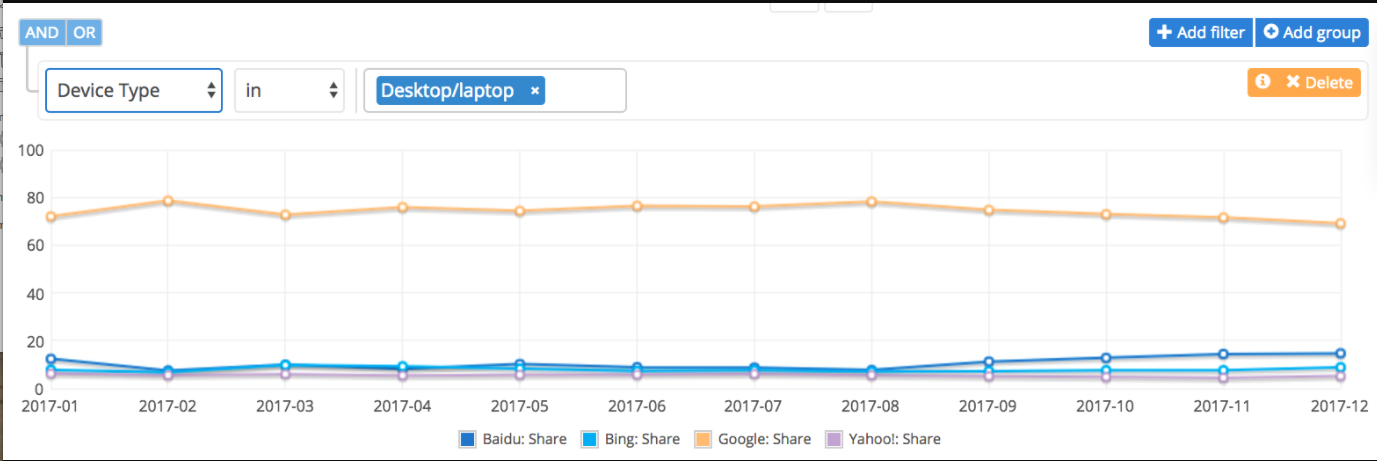
- Yahoo averages 1 billion monthly users
- 600 million monthly users come from mobile
Is Yahoo Search Right For Your Business?
In most cases, I say yes. As we already covered, most marketers optimize with Google in mind. Which means optimizing for Yahoo will put you ahead of the competition, and give you a very good chance of capitalizing on Yahoo’s search traffic. Not only that, but because fewer people are focused on Yahoo you’ll face less competition in the first place, making it more likely that your site and content will receive a high rank. Of course, how much you invest in Yahoo search will depend largely on your audience, as there are differences in the demographics between people who use Google and those that turn to smaller search engines like Yahoo and Bing. Most noticeably, Bing and Yahoo users tend to come from Great Plains, Rust Belt, and southern states and tend to be more politically conservative than those that opt for Google. But here’s the big one: Yahoo traffic tends to convert better than Google traffic. That alone makes it a valuable tool, and well worth the investment.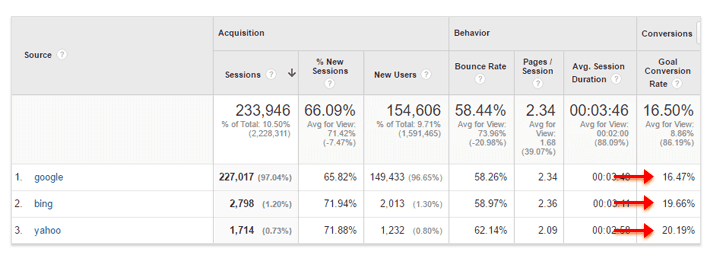
Key Ranking Factors for Yahoo Search
The best part about optimizing for Yahoo? Due to a partnership in 2009, Yahoo search is powered by Bing, meaning the same rules apply to both sites. It also means that you’ll be optimizing for two sites, not just one – a win/win. Let’s take a look at the some of the key ranking factors for both Bing and Yahoo search.- Content
- Use relevant keywords to build your content – note that unlike Google, to succeed on Bing and Yahoo you should use exact match keywords
- Focus on long-form content; it should be in-depth enough to cover all the reader’s expectations
- Content should be unique
- Use 301 redirects to pass the value of an old page on to a new one
- Produce new content consistently
- Links
- Start with a link building strategy
- Promote your links on social media
- Only link to relevant and related content
- Monitor your backlinks for quality
- Social Signals
- Avoid any social media schemes or automatic follower
- Don’t follow everyone that follows you; focus only on quality follows
- Post high-quality content and links to your social pages
- Technical SEO
- Page load time – faster load times produce a more positive user experience
- Robots.txt – this is very important, as it tells Yahoo how to interact with your site. As a best practice, Bing webmaster recommends placing the file at the root of your domain and maintain it over time
- Sitemap – these should be regularly updated to remove any old URLs
- Redirects – generally speaking, 301 redirects should be used unless a move is temporary
- Canonical tags – implementing a rel=canonical will help Yahoo determine your original URL in the case of duplicate URLs
Additional Tips for Yahoo Search SEO
While the above cover the major area of search optimization for Yahoo, there are a few additional factors ensure you rank as high possible.- First, focus on your tags. Keep your title and meta description tags clear and relevant. Also, remember to use h1 tags to help users and Yahoo understand the purpose of your page, and use only one per page
- Always submit an XML sitemap and keep it clean and updated, but enable both HTML and XML
- Be cautious with rich media. Though Yahoo and Bing can crawl multimedia sites better than Google, they still stress that you shouldn’t bury content in images and rich media
- Keep your URLs clean
- Keep your most valuable content close to your homepage
- Use the keyword you are targeting a few times throughout the content on a specific page, and include keyword variations as well
- Page titles should be roughly 65 words, while page descriptions should be roughly 160 or fewer characters