Home » Why Compounding Growth Is the Most Undervalued Digital Marketing Strategy for Investors
Why Compounding Growth Is the Most Undervalued Digital Marketing Strategy for Investors
Most companies in the $20 to $400 million stage are doing a lot of digital marketing, but very few feel confident that it is actually working as well as they want. But often, that is the wrong mindset entirely.
Budgets are spread across channels. Teams are busy. Reports are delivered monthly. Yet leadership still asks the same questions.
What is actually driving growth
What should we double down on
What does success look like next year, not just this quarter
As we move into 2026, the companies that scale successfully are the ones that move beyond tactics and adopt digital marketing mindsets that scale companies built on systems, volume, certainty, and long-term return. If you want a baseline for how to structure that strategy end to end, start with my step-by-step guide on how to create a digital marketing strategy and then come back here.
This article is written for CEOs, executive teams, and investors who want to understand why growth has slowed, why marketing feels risky, and what a modern, scalable digital growth system should actually look like in 2026 and beyond.
Why Companies Fail to Scale Heading Into 2026
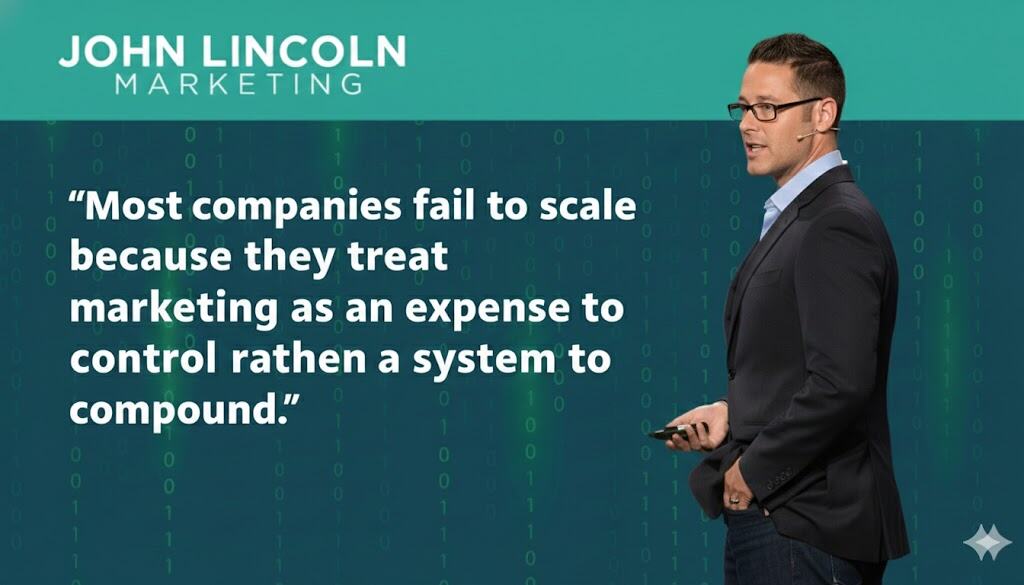
Most companies fail to scale because they treat marketing as an expense to control rather than a system to compound. I see it in nearly every program. It is the wrong mindset.
When profitability pressure increases, marketing is often the first place budgets are cut. The logic sounds responsible. Reduce spend. Protect margin. Improve short-term cash flow.
In 2026, this approach is even more damaging.
Digital marketing strategies to scale companies in 2026 require sustained investment in awareness, brand authority, and distribution across fragmented platforms. Pulling back spend not only slows growth, it removes your company from the places buyers now discover and evaluate brands.
Companies that scale successfully do the opposite. They over-invest in marketing and sales for where they want to be, not where they are today. They align spend to future revenue targets and build systems that allow them to invest more into what works.
The Biggest Lie About Scaling in 2026
Digital Marketing Strategy
The biggest lie people believe about scaling is that there is a hack that will deliver more results for less. Sure, there are some things that sqeeze more conversions out of current programs. But that being said, it is small thinking.
That belief becomes more dangerous in 2026, not less.
As platforms mature, competition increases, and AI-driven discovery reshapes demand, the companies that win are not the most efficient. They are the most committed to having the most robust growth engine.
The most effective are built on a willingness to pay more for high-value customers, dominate awareness in core categories, and invest ahead of measurable attribution. If you need a practical framework to forecast and scale what is working, see The Forecaster Method.
Trying to run marketing as a small, tightly controlled line item almost always produces limited outcomes. Consumers make decisions so quickly. If you want to be the best in the market, you need to make it clear to them you are the highest visible choice.
What the Modern Digital Landscape Means in 2026
The modern digital landscape in 2026 is defined by fragmentation, automation, and trust.
Buyers no longer move through linear funnels. They discover brands through AI search, social platforms, creator ecosystems, peer recommendations, and owned media. Attribution is delayed. Data is fragmented. Some products convert on the first click, such as water damage restoration or emergency plumbing, while others require time and repeated exposure, like a $100 hat you can wash.
Successful digital marketing strategies in 2026 start with clarity.
Clear audiences
Clear storytelling
Clear offers
Clear long-term nurturing systems
I’m not just making that up. Those bullet points are exactly what you need and almost no one is doing it right.
Modern growth requires sustained education and presence over ninety, one hundred twenty, and even year-long cycles. Brands that disappear between campaigns lose momentum quickly.
Attribution must move beyond last-click thinking. Linear attribution, weighted models, and revenue attribution are required to understand how awareness compounds into future demand. If you want a straightforward primer on how attribution works in practice, I break it down here: what is marketing attribution. For the official reference on how attribution is handled in GA4, Google’s documentation on getting started with attribution is a solid starting point.
AI Discoverability as a Core Growth Strategy
One of the most important shifts shaping digital marketing strategies to scale companies in 2026 is the rise of AI-driven discovery.
Traditional organic SEO and paid search are no longer the only gateways to visibility. Buyers increasingly rely on AI summaries, conversational search, and recommendation engines to evaluate options.
Attribution will not be perfect immediately. That does not reduce the importance of early investment.
The brands that invest now in structured content, authority signals, and consistent digital presence will be the brands surfaced most often as AI systems mature. If you want Google’s most direct guidance for site owners, review AI features and your website from Google Search Central.
What is overhyped in 2026 is demand-only advertising. Awareness is undervalued, and that creates opportunity for companies willing to invest ahead of short-term ROI. Almost every program I look at has an oversaturation in demand driven lower funnel.
Scaling Through Ecosystems, Not Channels
In 2026, customers live inside ecosystems, not channels.
They spend time on specific platforms, with specific creators, consuming specific formats. Digital marketing strategies to scale companies in 2026 must integrate deeply into these ecosystems.
This includes influencer partnerships, platform-native creative, integrated offers, frictionless lead capture or checkout, and persistent retargeting within the same environment.
Fragmented channel strategies produce fragmented results. Ecosystem-based strategies compound attention, trust, and conversion.
You Cannot Scale Digital Marketing in 2026 Without Scaling the Team
Scaling budget without scaling team capacity is one of the most common growth constraints.
Digital marketing strategies to scale companies in 2026 require organizational design, not just spend.
You need a senior strategic leader overseeing the full program. You need strategic owners at the business unit level. You need channel specialists, implementation teams, analytics support, and strong project management.
Marketing in 2026 includes thought leadership, digital PR, awards, conversion rate optimization, analytics, attribution, and continuous testing. Without the right structure, increased spend produces inefficiency rather than growth. If you want a practical way to reinforce authority while supporting SEO, this guide on using digital PR and SEO together is a good reference point.
Creative as the Primary Growth Lever in 2026
Creative is one of the most powerful and underutilized levers in modern digital growth.
Strong creative allows companies to build durable audiences across customers, prospects, video viewers, subscribers, followers, and lookalike segments.
In 2026, once someone interacts with your brand, the ability to stay in front of them with consistent, relevant messaging becomes a major competitive advantage.
High-quality creative reduces reliance on cheap clicks and increases lifetime customer value over time. If your leadership team is stuck on cost per click and cost per acquisition, reframe the conversation around customer lifetime value and the long-term economics of acquiring a higher-value customer.
A Scalable Digital Marketing Framework for 2026
Effective digital marketing strategies to scale companies in 2026 answer three questions.
Where are we today
Where do we want to be
What systems must be built to get there
Start with a full audit across awareness, consideration, conversion, and retention. Identify gaps. Protect what is working. Scale proven initiatives before adding complexity. If you want an objective way to pressure test performance against the market, use a benchmarking approach. Here is my guide to benchmark marketing and KPIs.
Invest more in awareness than feels comfortable. Ensure your brand is the top choice wherever buyers research. Measure success through total customer value and lifetime value, not just cost per click or cost per acquisition.
Use modern reporting that separates branded and non-branded demand to understand how awareness contributes to long-term revenue. On the paid side, align budgets and bidding to how growth actually works. Google’s official overview on choosing your bid and budget is a useful reference for leaders who want clarity on how budget constraints and bidding mechanics affect outcomes.
The Three Non-Negotiables for Growth in 2026
Every scalable company in 2026 shares three characteristics.
A great product
An exceptional customer experience
A sales and marketing first mindset
Product without distribution stalls. Customer experience without awareness limits growth. Sales and marketing without conviction produces inconsistency.
When these three are aligned and funded properly, growth becomes predictable.
This is What Works
Digital marketing strategies to scale companies in 2026 are not about doing more tactics. They are about building systems that compound.
Leave a Reply
Welcome To John Lincoln Marketing
Welcome to John Lincoln’s personal website. You can learn about John Lincoln’s books, films, book him to speak and contact him. John is directly associated with many of the businesses mentioned on this website and freely discloses this information.
About the Author
John Lincoln is CEO of Ignite Visibility, one of the top digital marketing agencies in the nation. Outside of Ignite Visibility, Lincoln is a frequent speaker and author of the books Advolution, Digital Influencer and The Forecaster Method. Lincoln is consistently named one of the top digital marketers in the industry and was the recipient of the coveted Search Engine Land “Search Marketer of The Year” award. Lincoln has taught digital marketing and Web Analytics at the University of California San Diego, has been named as one of San Diego’s most admired CEO’s and a top business leader under 40.
Google Search Quality Rater Guidelines Compliance Checklist Google’s Search Quality Rater Guidelines (SQRG) are not a direct ranking algorithm, but they are the playbook human