Apr 26, 2018 · 9 min read
Should Brands Be Using Snapchat for Business?
Snapchat has yet to find its way into many marketer’s social media strategies.
It’s no surprise, really. It’s a risky channel for most brands, and success certainly isn’t guaranteed.
In this article, I’ll make the case for why you should – or shouldn’t – be using Snapchat for your business.
The Case for Snapchat for Business
It’s easy to dismiss Snapchat. And the reality is, many brands should. It’s certainly not for everyone – for example, if you find a lot of success marketing to professionals on sites like LinkedIn, you may want to steer clear of the snaps. Of course, there’s a but here. Because there are some brands who are killing it on Snapchat, and some compelling reasons why it might be worth a try. First, let’s let the numbers do the talking:- Snapchat has over 100 million daily active users, and 54% log in every day.
- Snapchat reaches 18% of the US’s entire digital population.
- There are 1 million snaps created every day
- Users spend an average of 30+ minutes on the app every day
- Snapchat’s daily reach (of 18-34 year olds) in the US is 41%
First of all, Snapchat is completely different than any other channel out there.
While this comes with its difficulties, it also comes with a lot exciting opportunities. Take what General Electric’s done. From the Owen Campaign to the interior of volcanoes, the company (that let’s be honest, no one expected to excel on Snapchat) has used the platform to take its viewers along on its many journeys. And hey, if it doesn’t work, the story will simply disappear. No harm, no foul, right?On that same train that of thought, it’s an incredibly authentic way to showcase your brand’s story.
Because of its format, Snapchat is extremely well-suited to behind-the-scenes content from brands and its employees. As you know, that’s how some of the best brand stories are told. Those stories are what connects brands to their audience and build a more authentic, personal relationship. And if you can build that kind of relationship with your users, they’re much more likely to convert to customers in the long run.And of course, there’s less competition.
Standing out on social media is no easy task. Most brands have a well-rounded social media strategy that includes all the big guns like Facebook, Twitter, Instagram, etc. Far less have extended that strategy to Snapchat, which means brands that do make the jump have a much greater opportunity to stand out.Last but not least, Snapchat’s making some changes.
Over the last few months, Snapchat’s been upping its game to compete with the bigger social media channels. Some of the new features include three new ad tools. One lets you filter by location by category, so you can target your audience based on the type of place they currently are. For example, a restaurant, a movie, etc. Another new tool allows radius targeting to better target by location. The last new tools provides info about the age, gender, and interests of Snapchat users who visit your store. Snapchat also introduced Context Cards late last year, which “provide a way to take simple actions like calling for a ride with Uber or Lyft or reserving a table through OpenTable, Resy or Bookatable.” The takeaway is that Snapchat is only making it easier for brands to target and connect with an audience. It has a vested interest in attracting more advertising dollars, and with more options available, more brands are likely to jump on board. So yes, there is a compelling case why Snapchat should be used for business. But let’s play Devil’s Advocate for a minute.The Case Against Snapchat For Business
While there’s a lot of opportunities to be had on Snapchat, there are cases where it simply isn’t worth the effort. One of the biggest concerns regarding Snapchat?It simply falls behind the competition.
In what should have been a win for Snapchat, it’s largely popular Snapchat Stories soon lost out to Instagram. A study by Delmondo found roughly a 40 percent drop in unique viewers after measuring 21,500 Snapchat Stories starting in July 2016 (just before Instagram stories came out) through November 2016.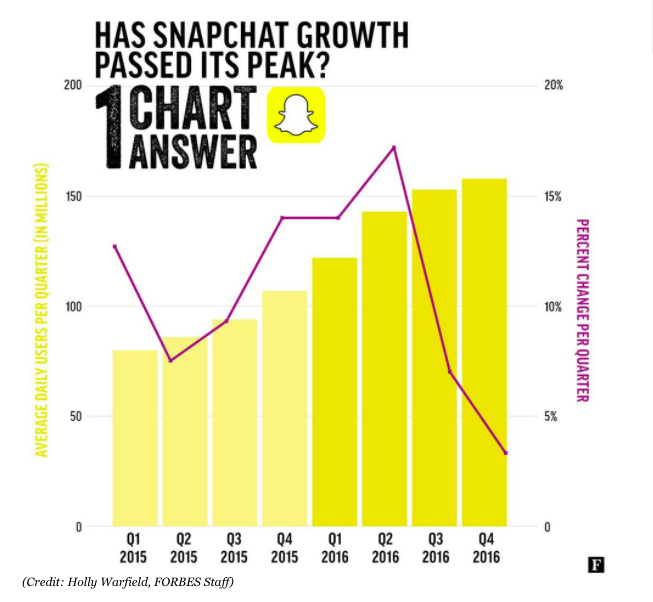
Another thing? Its audience may be fleeting.
The vast majority of Snapchat’s users are in the 18-34 year old demographic (no surprise there). While in itself not a bad thing, this particular demographic has the potential to be less loyal to brands and more likely to follow what’s on trend. Which means that should a new, cool social platform pop up, its users may jump ship. For brands, that means a Snapchat-heavy strategy could fall on deaf ears.Snapchat also sees a much smaller audience overall.
Again, this one could go either way. A smaller audience means fewer brands, and therefore less competition. But it also means, well..a smaller audience, and less overall reach for brands. Some brands simply can’t justify investing in a platform that doesn’t have the numbers. It would also be remiss not to mention influencer marketing. It’s a big deal in marketing strategies on photo platforms like Instagram, where it’s proven to be an excellent way for brands to gain exposure. On Snapchat, however, influencers are far less prevalent.And sadly, it just can’t stand up to Instagram.
Instagram Stories users have more users than Snapchat does as a whole. It has more influencers, and it has the support of Facebook and all its advanced features to back it up. With that comes more access to advertising options, targeting options, and analytics. Because the two platforms are so often compared (and let’s face it, so similar in many ways), it’s not hard to see why many marketers favor Instagram over Snapchat.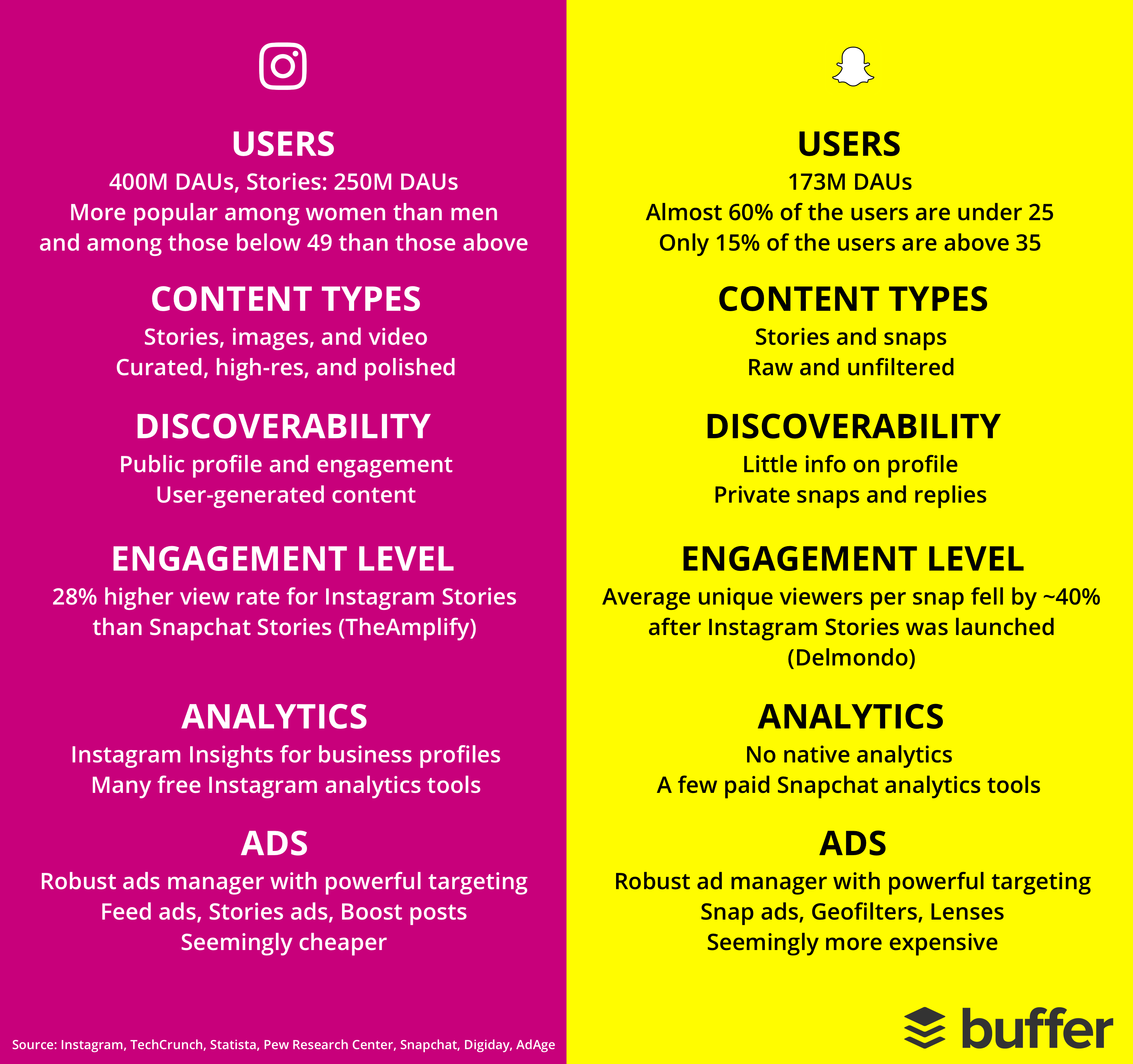
So, Should Your Brand Be Using Snapchat for Business?
To determine that, you first have to look to your target audience. Here’s what we know about Snapchat:- 85% of Snapchat’s 158 million daily users are between the ages of 18 and 34
- Just 15% of users are 35-and-up
- The population is currently made up of 70% women and 30% men.
- Your audience is there – run surveys, etc. to find out if your target audience is really using Snapchat
- You can tell a compelling brand story – almost any brand can find a way to spin an engaging story, but be honest here. If you don’t have the time or manpower to invest in delivering a great story, Snapchat may not be the channel for you
- Use high-quality video – your photos and videos should look professional and high-quality; if they’re not, your audience will have a hard time engaging
- Market your Snapchat on other channels – include social buttons to your account on your website, blogs, and emails, and send people to your Snapchat account via Facebook, Twitter, etc. (include links, your Snapchat code, invite them to participate in contests on Snapchat, etc.)
- Post often – Snapchat posts disappear quick, and if you’re not continuously posting, it’s likely your audience will never see them. Make sure you have a content schedule created and tools set up to keep you on track
- Engage with your audience – while storytelling is a crucial part of a Snapchat strategy, make sure you’re including posts designed to engage with your audience. Run contests on the platform, ask questions and prompt users to respond with a Snap, and of course, respond in kind when asked